De-Flock Is the Easy Part. Deprovisioning Is the Story
Harrisonburg set a dark date. South Kingstown ordered cameras out. Connecticut reporting shows nationwide sharing is a default. Ending Flock is not the same as killing the access graph.
Councils are learning how to say no to Flock Safety in public. That is real. It is also the easy sentence.
The hard sentence is the one almost nobody can answer on the night of the vote: who can still query what, for how long, from where, after the cameras “go dark”?
This week the receipts arrived in a cluster. Harrisonburg, Virginia, voted 4–0 to end its Flock contract and heard its city manager put a near-term dark date on the record. South Kingstown, Rhode Island, voted unanimously to terminate Flock and remove about six cameras after an ACLU letter and a packed room. Connecticut reporting put the architecture in plain English: nationwide sharing is a setting the town has to turn off. California’s Chico, running Motorola readers rather than Flock, showed why that architecture matters—public records put ICE, Border Patrol, and dozens of out-of-state agencies on an access list until the chief said the share was shut off.
Do not merge those vendors into one cartoon. Do not treat a cancel vote as a wipe. The product worth building is an exit and access audit, not a victory lap.
What changed in late July
Harrisonburg put a dark date on the record
WHSV reported that Harrisonburg City Council upheld its pledge to end the city’s Flock contract in a unanimous 4–0 vote on Tuesday night, July 28. The recorded yes votes: Mayor Deanna Reed, Vice Mayor Dany Fleming, Council Members Laura Dent and Monica Robinson.
City Manager Ande Banks said the contract will end and systems will go dark on Friday. Relative to that reporting window, treat Friday as July 31, 2026 unless the official minutes say otherwise. Banks also said the city will remove the cameras if removal is “taking too long.” WHSV noted the city did not define that delay.
Local organizers from Deflock Harrisonburg celebrated the end of the contract and said cameras had been bagged pending removal. Their remaining demand—an ordinance blocking future “mass surveillance” vendors—did not pass. Council did put a policy in place encouraging future councils to evaluate ALPR concerns. That is not the same thing as a hard ban.
A dark date is a falsifiable claim. Either the feed stops collecting on Friday or it does not. Physical removal, historical retention, and external search rights are separate claims. Demand proof for each.
South Kingstown ordered termination and removal
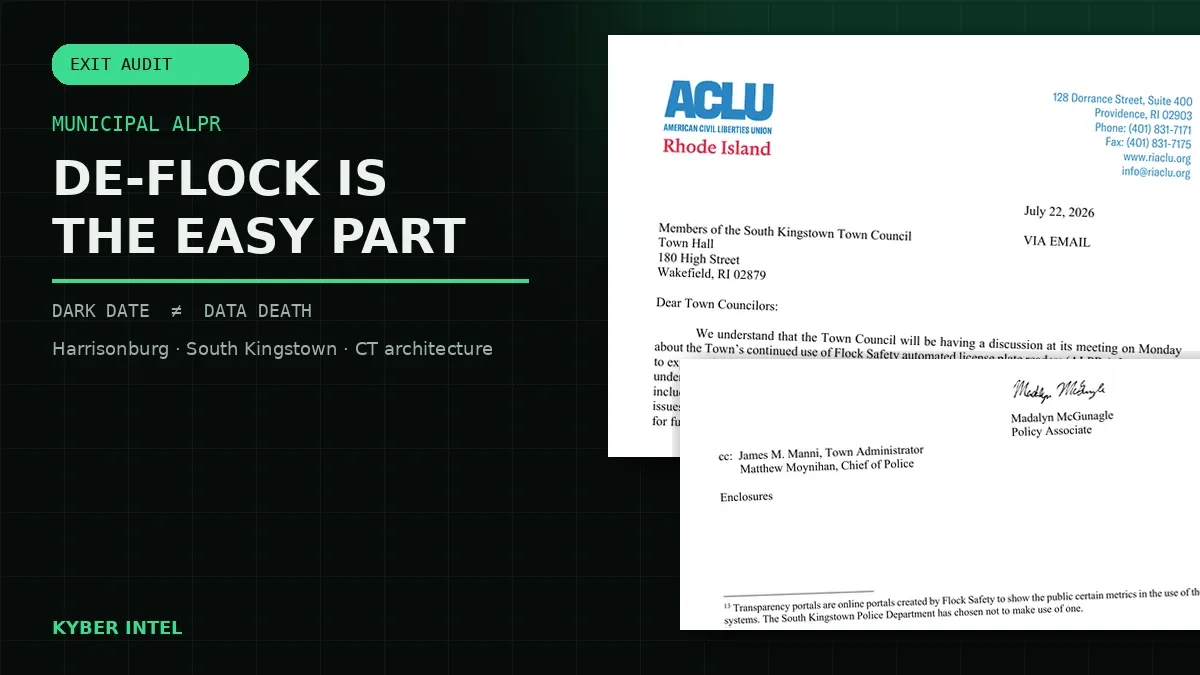
The ACLU of Rhode Island reported on July 28 that the South Kingstown Town Council voted unanimously the night before to terminate the town’s Flock contract and remove the half-dozen ALPR cameras in town. The contract had been approved in June 2025. Constituents packed the meeting. Councilors questioned a Flock representative. The ACLU’s four-page letter was already on the table.
Kyber has the letter. It is primary advocacy, signed by policy associate Madalyn McGunagle, dated July 22, 2026, and addressed to the Town Council with copies to the town administrator and police chief. It is not a judicial finding. It is the document the civil-liberties side put into the official conversation before the vote.
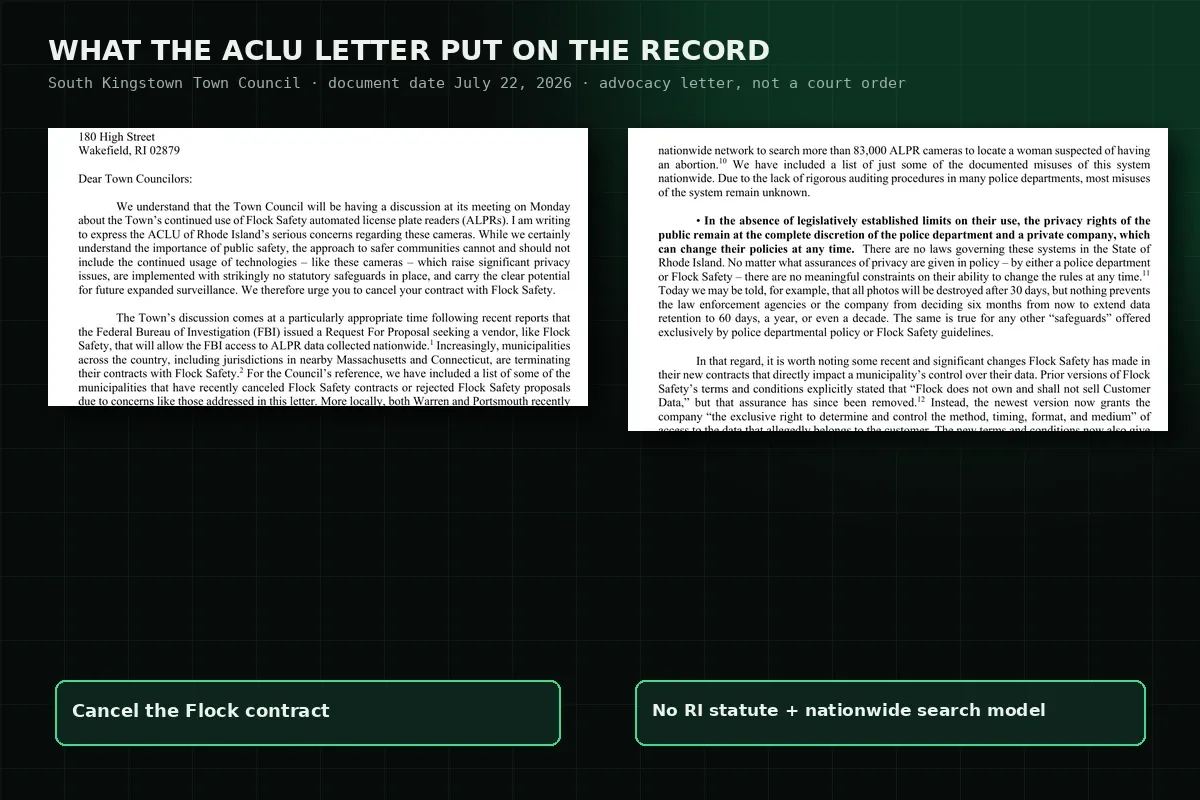
Source: ACLU of Rhode Island letter to the South Kingstown Town Council, document date July 22, 2026. Narrow excerpts for reporting and criticism. The letter is advocacy analysis, not an adjudicated misuse finding for South Kingstown specifically.
What the letter actually argues, in compressed form:
- ALPRs can be searched by more than plate text—vehicle type, make, color, roof racks, bumper stickers.
- Results can reach beyond one town through a nationwide sharing network.
- Rhode Island has no statute governing install and use the way some other states do; policy can change without a legislative fight.
- Recent Flock contract language, as the ACLU reads it, drops older “Flock does not own and shall not sell Customer Data” assurances, grants the company exclusive control over the method of data access, and includes a perpetual right to use customer data to “support and improve” services—plus Georgia governing law.
- The ACLU cites secondary reports of CBP access, ICE lookups via partners, protest monitoring, stalking, and a Texas abortion-related nationwide search. Those are citations to other reporting and audits, not new South Kingstown incident logs in this package.
The ACLU also enclosed a multi-page list of localities that canceled, rejected, suspended, or declined Flock and other ALPR systems. Treat that table as ACLU compilation, useful as leads, not as Kyber’s verified national census.
Connecticut put the default in English
CT News Junkie reported on July 29 that a second Connecticut municipality had turned off Flock cameras after resident concerns. The article’s body, as captured for this package, cleanly names Windsor (temporary disable in February, permanent contract end in June), Killingworth (negotiating an end; $14,600 budgeted for four cameras), and Milford (three Boston Post Road cameras vandalized July 15; investigation ongoing).
Kyber is not inventing the identity of the headline “second” town from a title alone. If council minutes later name it, update the watchlist. Until then, use the named threads.
The architecture paragraph is the part that should be taped above every council desk:
Flock Safety cameras allow for sharing the collected data nationwide with other departments and federal agencies, unless the local municipality turns that setting off.
In Windsor, CTNJ reports, data from 16 cameras was initially and inadvertently shared nationwide before access was limited. A resident told council the data gathered in Windsor “does not stay here.”
Flock’s counterparty line
CTNJ quotes Kevin Kane, Flock’s director of government affairs: the company faces “significant misinformation”; Flock does not itself share with federal agencies because data belongs to each municipality and sits on Amazon Web Services; each search requires a stored justification; some departments publish transparency portals with camera counts, access lists, prohibited uses, and search volumes.
Hold both ideas at once. Municipal ownership on paper is compatible with a multi-tenant cloud product whose default share graph is wide. A vendor saying “we don’t share, the city does” is an access-control story, not a privacy lullaby.
Chico is the access-graph companion—not a Flock twin
ChicoSol’s July 25 investigation is about Motorola ALPR hardware and dashboards, not Flock. Keep the brands separate.
What ChicoSol reports from public records and on-record interviews:
- Dashboard records as recent as July 7, 2026 showed about 20 federal and more than 80 out-of-state agencies with access, including ICE ERO, ICE HSI, and Border Patrol.
- ICE MOUs dated back to February 28, 2024.
- Chief Billy Aldridge said the department discovered the external share while producing a Public Records Act response, that it “shouldn’t have been sharing” outside California or with federal agencies, and that sharing was shut off.
- An audit was incomplete. The chief said federal agencies had accessed the system without successful plate hits so far, with millions of records still unaudited.
- At publication, policy language authorizing external MOUs remained live on the city site even as a rewrite was promised.
- ACLU of Northern California senior staff attorney Nick Hidalgo called California’s limits “crystal clear” under SB 34 and SB 54. That is a legal position, not a court judgment in this package.
Chico is the reason “we canceled the cameras” is not enough. Access graphs can outlive political speeches. Sometimes they outlive the chief’s understanding of what was configured.
Evidence boundary
Publication-ready:
- Harrisonburg’s 4–0 termination vote and city-manager dark-date statement, as reported by WHSV.
- South Kingstown’s unanimous terminate-and-remove vote, as reported by ACLU RI, plus the contents of the July 22 letter PDF.
- CTNJ’s description of nationwide default sharing, Windsor’s path, Kane’s AWS/municipal-ownership line, and the named CT threads.
- ChicoSol’s PRA-based Motorola access-list reporting and the chief’s attributed shutoff claim.
Not proven here:
- That any city’s historical ALPR images, exports, backups, or partner copies were deleted.
- That external ACLs are zero after a cancel vote without admin UI, API, or audit-log proof.
- A national collapse of ALPR networks, State Police systems, private retail/HOA cameras, or neighboring feeds.
- ACLU numerical estimates (for example “over 290” Rhode Island Flock cameras, or “more than 50” U.S. municipal ends) as Kyber’s own count.
- The legal conclusion that Chico violated SB 34/SB 54, or that any named officer committed a specific misuse in Harrisonburg or South Kingstown.
- That Flock’s perpetual improve-services license means every source frame is kept forever. A perpetual license and a source-data retention period are different contract objects. Kyber has already covered that distinction in the Huntington Flock packet.
Do not confuse:
- completed termination vote;
- announced dark date;
- physical removal;
- temporary disable;
- non-renewal;
- debate only;
- claimed share shutoff without proof.
The deprovisioning map
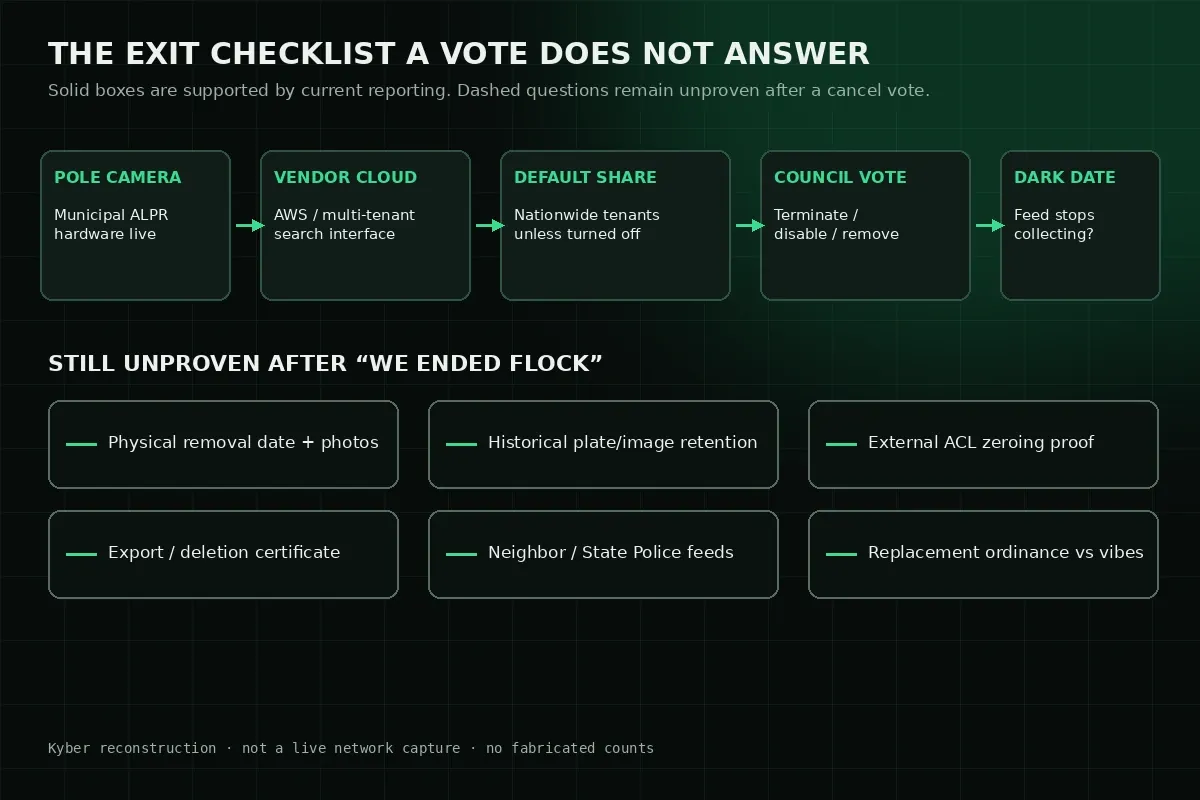
Kyber reconstruction from the late-July reporting cluster. It is not a live network capture, device map, or allegation that every city fails every step. Dashed questions stay open until records close them.
A competent exit has at least six receipts:
- Action class — completed termination, announced termination, non-renewal, temporary disable, reject-before-install, or talk.
- Dark date — collection stops, with a calendar day.
- Physical removal — poles empty, not just bagged, with date and inventory.
- Historical fate — delete, retain, export, legal hold, or “vendor improves products forever” language.
- External ACL proof — who could search before; who can search after; MOUs revoked; partner list empty.
- Replacement rule — ordinance, procurement ban, retention cap, or nothing but vibes for the next council.
If a city can only answer item 1, it held a press conference, not an exit.
Municipal ALPR Exit & Access Watchlist — seed
| Locality | Vendor | Action class (as of 2026-07-29) | Clock | Open proof |
|---|---|---|---|---|
| Harrisonburg, VA | Flock | Termination vote + announced dark date | Dark Friday after 7/28 vote | Removal SLA, ACL wipe, retention |
| South Kingstown, RI | Flock | Termination vote + remove ~6 cameras | Removal deadline unpublished | Minutes/video, deletion, neighbor/State Police feeds |
| Windsor, CT | Flock | Permanent end after temp disable | June permanent end (CTNJ) | Post-exit ACL proof, historical fate |
| Killingworth, CT | Flock | Negotiating end (CTNJ); ACLU list marks cancelled 7/15/26 | Status conflict—preserve both | Final instrument, disable proof |
| Milford, CT | Flock | Live system + vandalism investigation | 3 cameras damaged 7/15 | Not an exit story; criminal investigation only |
| Chico, CA | Motorola | Claimed external-share shutoff + audit | Shutoff claimed 7/8 after PRA | Audit completion, policy rewrite live text, hit logs |
This table will age in hours. That is the point. Update rows when minutes, vendor letters, or PRA dumps land. Do not freeze a Tuesday night speech as permanent infrastructure truth.
Vendor and agency position
Flock, through Kane in Connecticut, says the company is fighting misinformation, does not itself push data to federal agencies, stores municipal data on AWS, requires search justifications, and supports transparency portals.
Local police arguments in the same Connecticut piece are the familiar ones: burglaries, robberies, assaults, hit-and-runs, missing people.
Harrisonburg’s manager put operational language on the record: contract ends, systems dark Friday, remove if slow.
South Kingstown’s council action is reported by ACLU RI as a privacy win after constituent pressure; Flock’s own statement on that specific vote was not located for this package.
Chico’s chief says the system was for criminal investigations and missing persons, not immigration; he claims the illegal-looking external share was shut off once discovered; the audit continues.
Believe none of these as a substitute for configuration evidence. Quote them as positions.
What readers can do lawfully
If your town is buying, keeping, or “ending” ALPRs:
- Ask the six exit questions in public comment. Demand calendar dates, not adjectives.
- File records requests for the contract, order forms, sharing toggles, MOUs, network/organizational audit logs, retention settings, deletion certificates, and any transparency-portal configuration.
- Check whether a transparency portal exists and what it actually discloses. Absence is itself a data point—the ACLU RI letter notes South Kingstown had not used one.
- Map the whole road, not one vendor. State Police units, neighboring towns, tolling systems, and private cameras can still observe the same corridor after a municipal cancel.
- Push for statute and ordinance, not vibes. Policy that lives only in a police manual or vendor portal can change without a public fight. The ACLU RI letter’s core structural point stands even if you reject every secondary misuse citation: discretion is not law.
- Do not damage, obstruct, bag, jam, or steal equipment. Vandalism is a crime, creates defendants instead of records, and is not a Kyber recommendation. Track it only as a political/security signal when local outlets report it.
For personal exposure while the poles are still up: treat plate-linked travel as potentially logged; prefer routes and habits that do not require you to trust every retention promise; own your domain, email, and communications so mobility dossiers are not also your entire identity stack. None of that requires breaking the law.
How this connects
Kyber has already been on this architecture:
- The cameras are watching. Now people are cutting them down — backlash, charges, and lawful civic exits.
- License plate readers don’t need license plates anymore — vehicle fingerprinting beyond plate text.
- The Supreme Court’s geofence ruling does not settle the ALPR question — doctrinal limits.
- Huntington’s $2.1M Flock stack — ownership language vs interface-controlled exit and perpetual improve-services license.
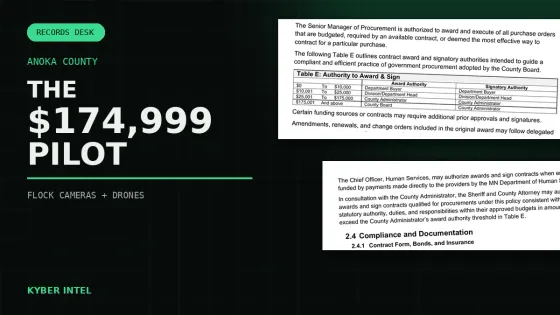
- Anoka’s $174,999 Flock/drone pilot — procurement path as the quiet install route.
The pattern is consistent. The power is not only on the pole. It is in the cloud ACL, the default share toggle, the contract’s exit clauses, and the records you can force into daylight.
Follow-up triggers
- August 1+: Did Harrisonburg actually go dark on Friday? Photos, city statement, or FOIA of disable logs.
- South Kingstown minutes/video and a dated removal inventory.
- Named identity and minutes for any additional Connecticut disable beyond Windsor.
- Chico audit completion, revised policy text replacing §449.5.B.1, and any AG or court action.
- Flock first-party statement on the Harrisonburg or South Kingstown exits.
- Any municipality that produces the rare artifact: a deletion certificate + empty external ACL export after termination.
Bottom line
Canceling Flock is becoming a learnable municipal skill. Good.
Deprovisioning is still rare, boring, and decisive. Better.
If your city only has a vote, it still has a surveillance residue problem. Ask for the dark date, the empty poles, the retention fate, and the access list with nobody left on it. Anything less is a headline with the database still warm.
Sources
- https://www.whsv.com/2026/07/29/harrisonburg-city-council-votes-end-contract-with-flock-safety/
- https://www.riaclu.org/news/south-kingstown-cancels-flock-safety-contract-after-community-advocacy-aclu-letter/
- https://www.riaclu.org/publications/letter-re-south-kingstown-town-council-considers-flock-safety-cameras/
- https://www.riaclu.org/app/uploads/2026/07/Letter-%E2%80%93-South-Kingstown-Town-Council-Flock-Safety.pdf
- https://ctnewsjunkie.com/2026/07/29/2nd-ct-town-disables-its-flock-cameras/
- https://chicosol.org/2026/07/chico-pd-granted-ice-border-patrol-access-to-its-alpr-data/