The Supreme Court’s Geofence Ruling Does Not Settle the ALPR Question
Flock says the Chatrie location-data ruling reinforces the legality of license-plate readers. The Court did not decide that—and network scale remains the fight.
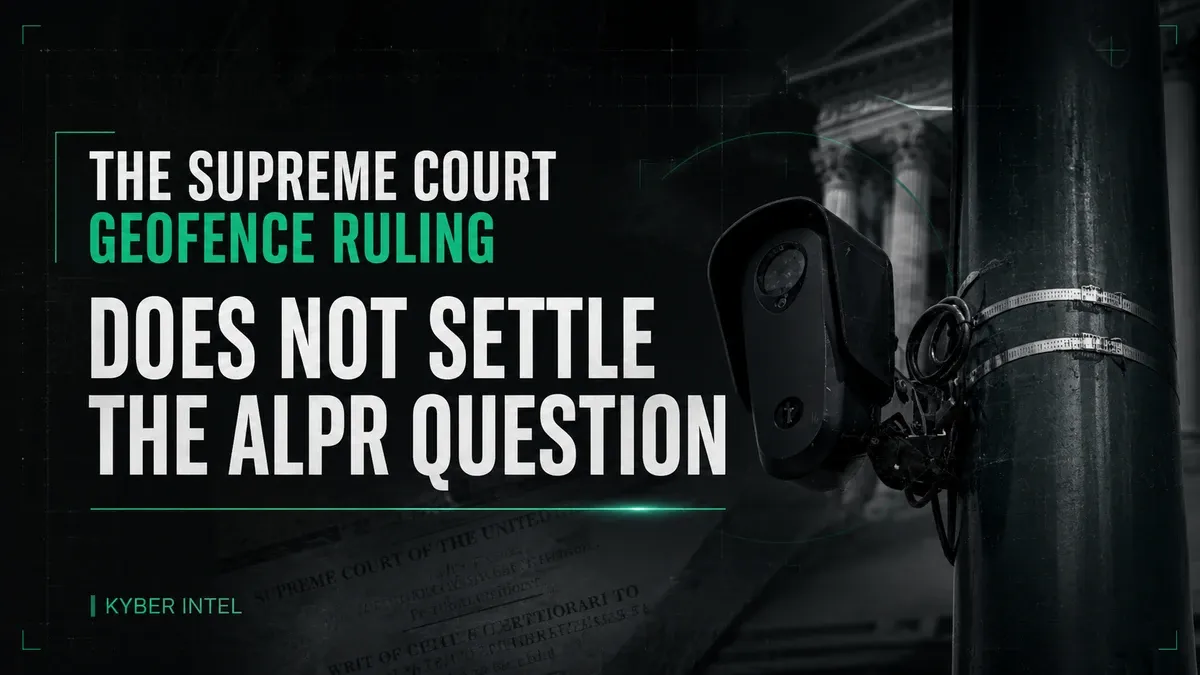
Flock says the Court reinforced the constitutional line between phone tracking and plate readers. That is the company’s argument—not the Court’s holding.
The Supreme Court ruled on June 29 that police conducted a Fourth Amendment search when they obtained Okello Chatrie’s Google Location History data through a geofence warrant.
Ten days later, Flock Safety published its preferred reading: the decision was not about automated license-plate readers, and the Court’s reasoning supposedly reinforces the lawfulness of cameras that record vehicles at fixed points on public roads.
The first part is indisputable. Chatrie v. United States was a phone-location case. The opinion does not decide whether a query of an ALPR database is a search, much less declare Flock unconstitutional.
The second part is advocacy.
The Court drew distinctions that help Flock’s argument. It also rejected a trick that should make every location-data vendor nervous: taking a small window from a giant retrospective database does not necessarily turn mass tracking into a small search.
That is where the ALPR fight now lives.
Hero image: Flock ALPR in Hayward, California, photographed by RailTypes, CC0. Graphic treatment by Kyber Intel. The court ruling is represented editorially; no generated image is offered as evidence.
What the Court actually held
Richmond-area police obtained a warrant directing Google to produce Location History data for phones within 150 meters of a robbed credit union during a one-hour window. The process began with anonymized device records, expanded the location window for a narrowed list, and ended with identifying information for three users, including Chatrie.
The Supreme Court’s holding was narrow and important:
Police officers conducted a Fourth Amendment search when they acquired Chatrie’s location data from Google because an individual has a reasonable expectation of privacy in his cell-phone location information.
The majority emphasized why Google’s data was sensitive. Location History could record a phone roughly every two minutes, estimate location within about 20 meters, reveal elevation, expose visits to private and politically sensitive places, and let police reconstruct movements after the fact.
The government argued that officers requested only a short period. The Court rejected the premise. Even short-term monitoring can reveal associations, and officials were selecting that short slice from what the opinion described as an all-encompassing database.
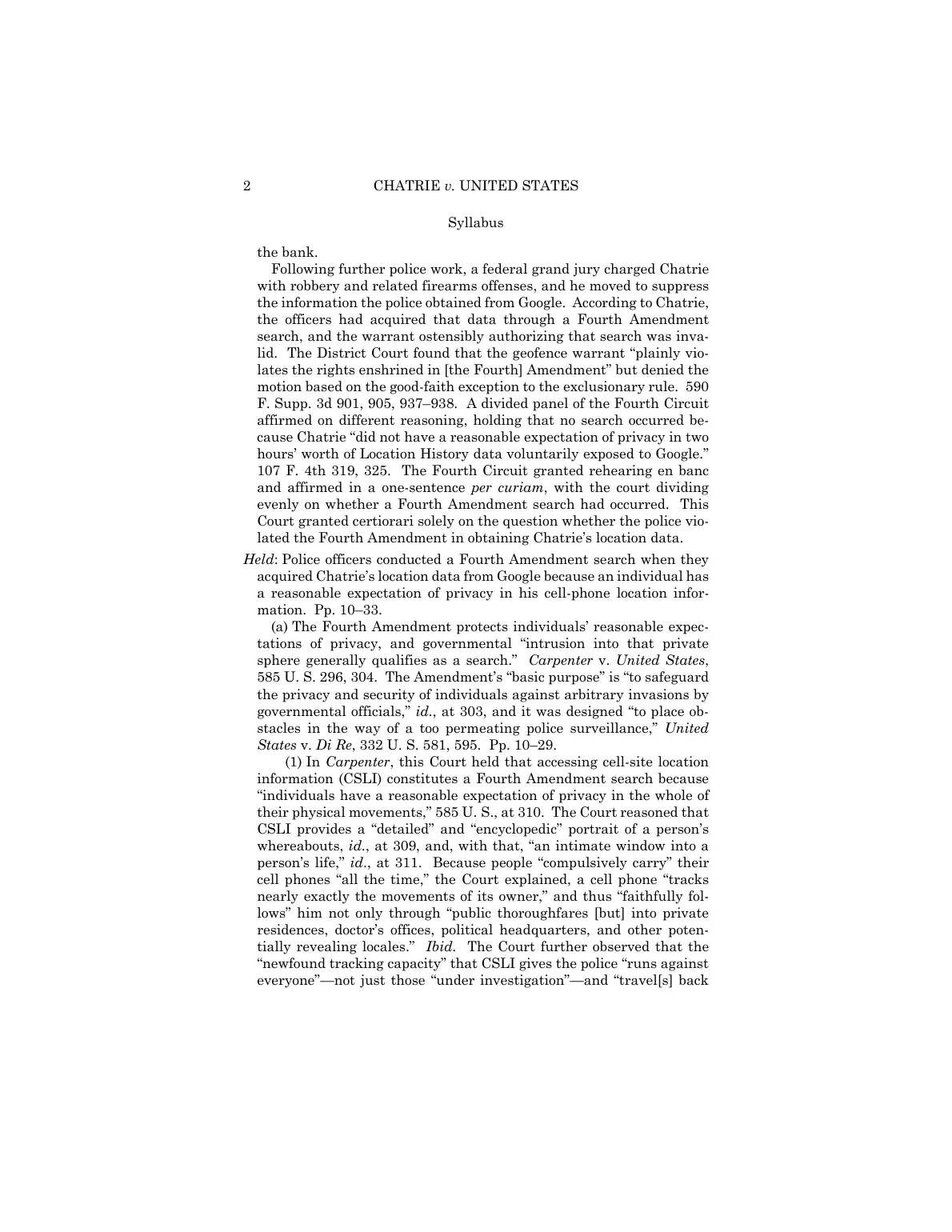
The Supreme Court’s syllabus states the holding and summarizes why Google Location History received Fourth Amendment protection. Source: Supreme Court slip opinion, June 29, 2026. U.S. federal judicial work reproduced for reporting; captured July 10, 2026.
The Court did not finish the warrant analysis. It sent the case back to the Fourth Circuit to address whether each stage satisfied probable cause and particularity. Saying government acquisition was a “search” does not automatically mean the search was unreasonable, the warrant was invalid, or the evidence must be suppressed.
That procedural limit matters. Constitutional reporting becomes fan fiction the moment “the Fourth Amendment applies” mutates into “the government lost every remaining issue.”
Flock’s case for why it is different
Flock’s July 9 response, written by its vice president of litigation, makes four main distinctions:
- ALPRs observe vehicles on public roads rather than following a phone into private spaces.
- A fixed camera produces discrete sightings only where cameras exist, not continuous tracking.
- Plate-reader data is narrower than a personal phone-location journal.
- Retention limits, audit logs, role-based access and local oversight constrain use.
These are real distinctions. A plate reader is not an ankle monitor and one camera observation is not a complete travel history. Flock’s policy says its LPR product records plate and vehicle images, plate number and state, vehicle characteristics, time, date and camera location. It says the product does not collect a driver’s identity or facial-recognition data.
A plate is also not a person. Ownership records, shared vehicles, rentals and borrowed cars complicate identification.
Any serious challenge has to deal with those facts instead of pretending every location technology is the same machine wearing a different case.
The network is the unanswered question
Flock’s strongest argument describes a camera. Its hardest problem is the database.
One sighting is a discrete observation in public. A searchable series of sightings across many cameras and jurisdictions can reveal routes, routines, visits and associations. The constitutional question is not resolved merely by saying each sensor saw something visible from the road.
Scale changes what old observations can do.
Chatrie matters because the Court refused to judge only the two-hour slice police requested. It looked at the underlying system’s capacity to preserve and retrospectively expose movements. The majority wrote that Fourth Amendment protection does not begin only after government collects some magic quantity of data.
That does not prove a future ALPR challenge wins. It does weaken the lazy version of the defense: each plate was visible in public, therefore aggregation can never matter.
A future court could care about:
- how many cameras feed the accessible network;
- whether the query is local, statewide, national or federated;
- the retention period that applied to the actual data;
- whether results expose a single observation or a movement pattern;
- how agencies link plates to people;
- what warrant, statutory or policy rules govern the search;
- whether outside agencies can query the data;
- and what the government did with the results.
There is no honest universal answer because there is no universal deployment.
Safeguards are evidence, not absolution
Flock points to audit logs and access controls. Good. A surveillance system without those controls would be even worse.
But auditability is retrospective. A log can show that a query happened. It does not necessarily stop the query, prove that the search returned a hit, or establish that anybody was identified, stopped, arrested or convicted.
Official records already show why implementation matters. Illinois’s secretary of state concluded in 2025 that Flock allowed Customs and Border Protection to access Illinois camera data during a federal pilot in violation of state law. Mountain View, California, later said an audit found a nationwide-search setting enabled without its police department’s permission or knowledge. The city could not determine whether the federal searches returned plate information because the needed historical records were unavailable.
Those incidents do not prove every deployment is unlawful. They prove “local control” is a factual claim that should be tested against settings, sharing lists and logs—not accepted because it appears in a sales deck.
What residents can do now
You do not need to wait for the Supreme Court to decide a hypothetical national ALPR case.
- Get the contract and renewal date. Find camera count, price, retention, sharing, deletion, audit and termination terms.
- Request the approved policy. Compare the policy elected officials saw with the capabilities administrators can enable.
- Request sharing records and audit logs. Ask for date ranges, outside agencies, stated purposes and whether searches returned results. Do not equate a query with a hit.
- Ask whether warrants are required. Separate law, written policy and actual practice.
- Identify the network boundary. Local cameras, shared cameras, statewide search and national search are different access mechanisms.
- Push for public reporting. Search totals, outside-agency access, misuse findings, discipline and policy exceptions should not require a leak.
- Use renewal and litigation strategically. Councils can reject contracts. Courts can evaluate actual searches on actual facts. Both routes work better than vandalism, which mostly creates evidence for prosecutors.
For a practical starting point, read Kyber’s investigation, “The Cameras Are Watching. Now People Are Cutting Them Down.” It includes a public-records checklist, documented contract terminations and the legal risk of attacking surveillance hardware.
The constitutional fight has moved to aggregation
Flock is correct about the headline limit: Chatrie did not decide ALPRs.
That does not mean the opinion gave plate-reader networks a constitutional blessing. The Court treated retrospective location access as a search and refused to let the government minimize the intrusion by pointing only to the narrow time window it extracted.
The next serious ALPR case will turn on a real system, a real query and a real record of what government could retrieve. Privacy advocates should build that record now.
The camera on the pole is the visible part. The database behind it is the case.
This article provides general reporting and analysis, not individualized legal advice. Constitutional rules and statutory protections vary by jurisdiction and fact pattern.
Sources
- https://www.supremecourt.gov/opinions/25pdf/25-112_0am4.pdf
- https://www.supremecourt.gov/docket/docketfiles/html/public/25-112.html
- https://www.flocksafety.com/blog/what-the-supreme-courts-chatrie-decision-actually-means-for-alpr-technology
- https://www.flocksafety.com/legal/lpr-policy
- https://www.ilsos.gov/news/2025/august-25-2025-giannoulias-audit-finds-license-plate-reader-company-in-violation-of-state-law.html
- https://www.mountainview.gov/Home/Components/News/News/1203/284
- https://www.mountainview.gov/Home/Components/News/News/1211/284

.jpg)