The Cameras Are Watching. Now People Are Cutting Them Down.
Flock Safety built a searchable license-plate network. Cities are canceling contracts while alleged camera attacks produce felony charges.
Flock Safety turned license plates into searchable location records. The backlash is real. So are the criminal charges—and the lawful ways cities are pulling the plug.
Flock Safety cameras are easy to miss. A solar panel. A camera on a pole. Another beige box quietly recording traffic while everyone argues about phone tracking.
But Flock is not merely taking pictures of cars.
The company’s own license-plate-reader policy says its system stores plate and vehicle images, plate number and state, vehicle characteristics such as color and make, the time and date, and the camera location. Flock says the default retention period is 30 days, although local law or policy can require a different period.
One read is a point on a map. Enough reads become a history of where a vehicle appeared and when.
Flock objects to calling that continuous tracking. Technically, it is right: an automated license-plate reader is not a GPS transmitter attached to a bumper. That distinction does not make the network harmless. A searchable series of time-and-location records can still reveal visits, routines, associations, and travel between jurisdictions.
That is why the backlash has moved beyond obscure privacy meetings. Cities have terminated contracts. State officials have found unlawful data sharing. Residents are demanding audit logs. And in Virginia and New Mexico, men accused of attacking Flock equipment now face piles of criminal charges.
The surveillance problem is real. Destroying the cameras remains a remarkably efficient way to convert a civil-liberties fight into a felony docket.
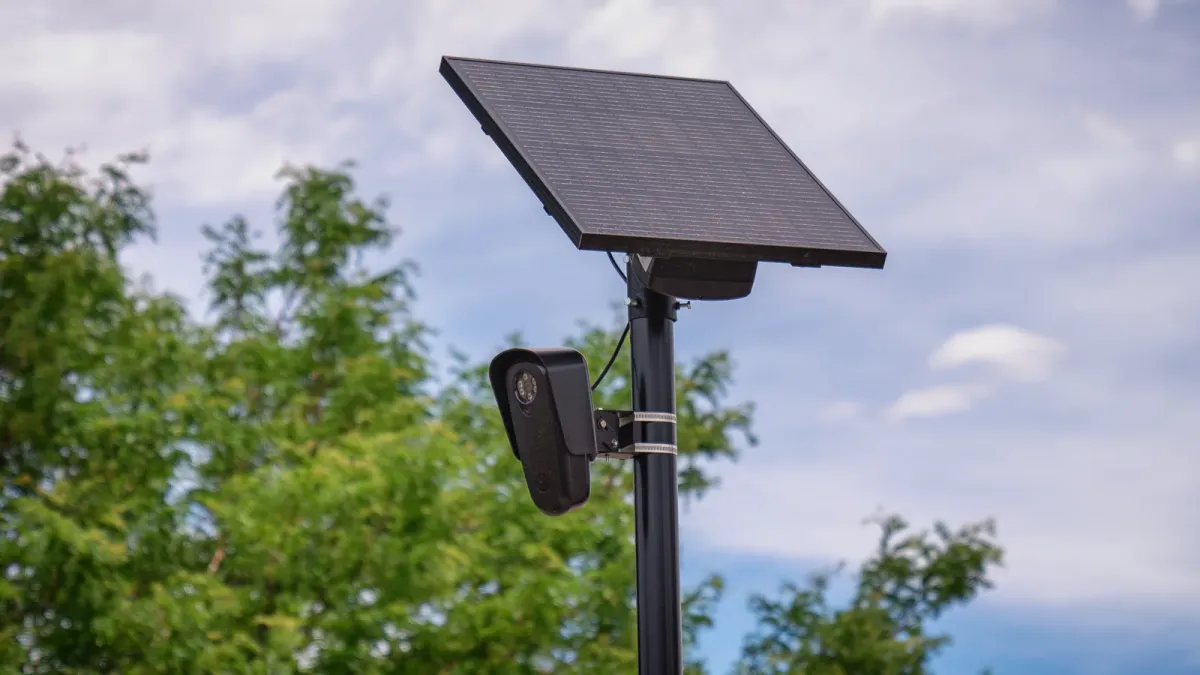
Above: A Flock Safety automated license-plate reader deployed with a solar panel in Aurora, Colorado. Photo by Tony Webster, CC BY 2.0. Cropped and compressed by Kyber Intel.
How to recognize a Flock camera
Flock’s Falcon plate readers commonly appear as compact black, vertically oriented camera units strapped to an existing utility or traffic pole. Some installations use a dedicated pole with a rectangular solar panel above the camera. Cabling, mounting hardware, enclosure color, and nearby equipment vary by installation, so shape alone is not proof that any particular device belongs to Flock.
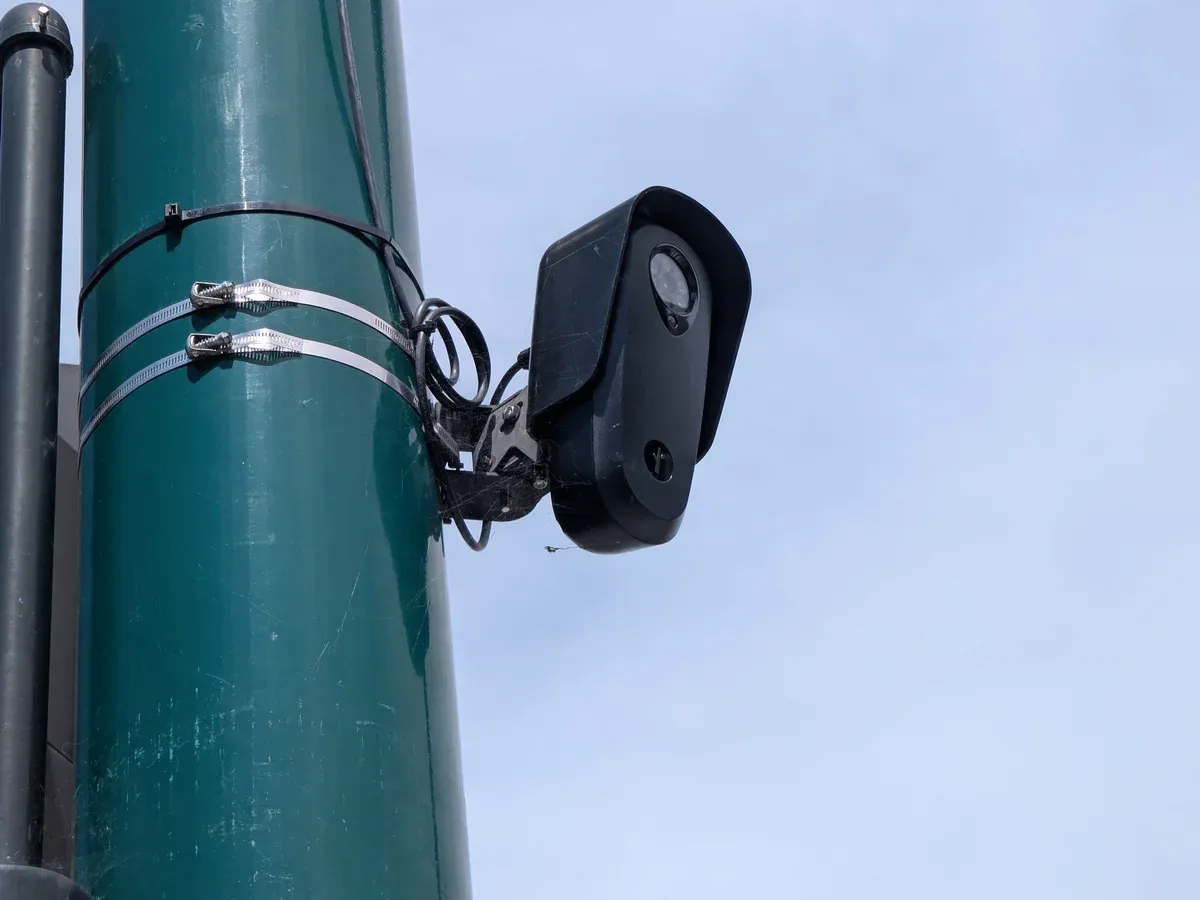
Close view of a Flock ALPR mounted to a pole in Hayward, California. Photo by RailTypes, CC0.
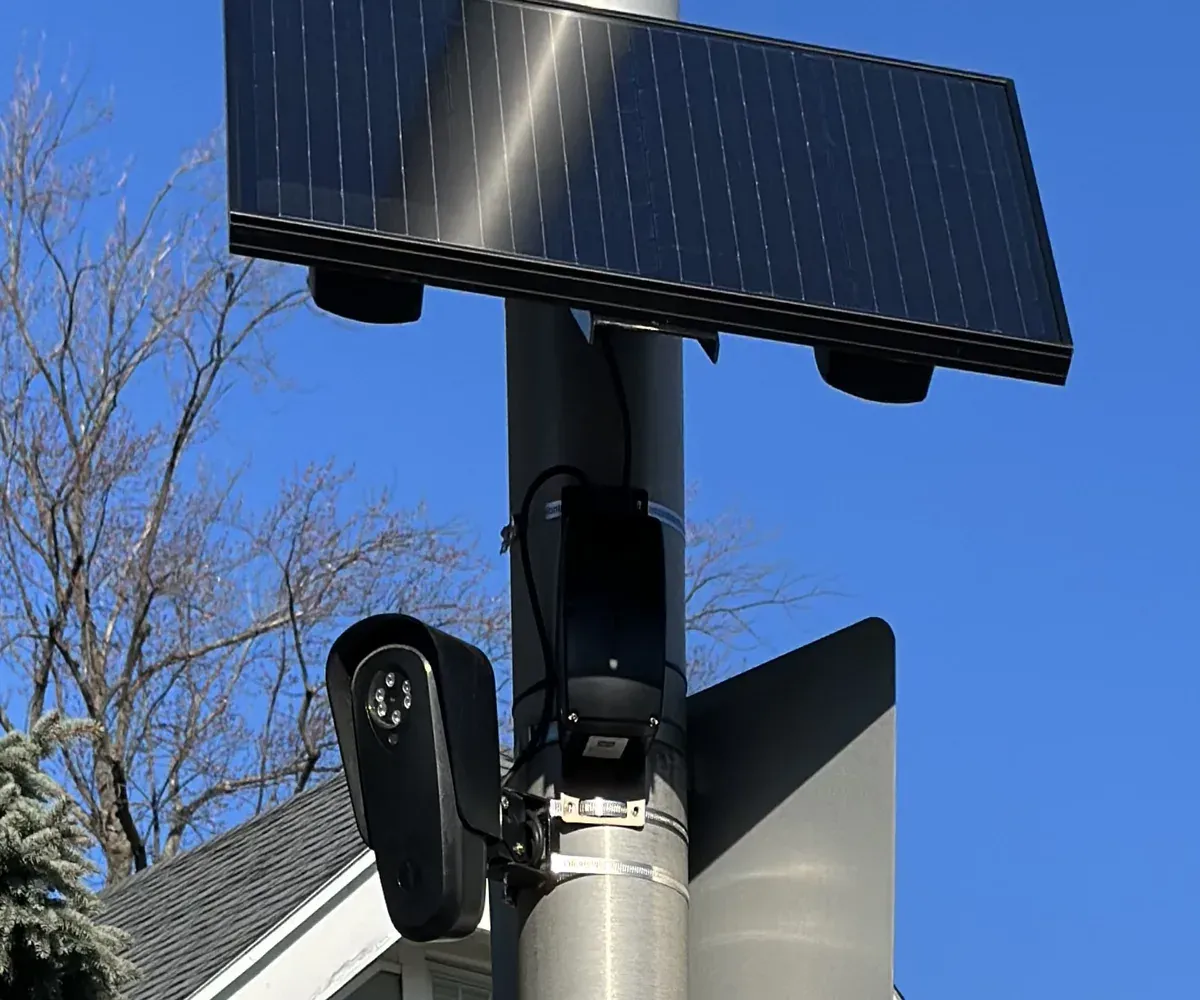
Another common deployment: a camera mounted below a self-contained solar panel. Photo by Bruxton, CC0.
These photos are included for public identification and reporting—not as a guide to touching, obstructing, disabling, or damaging equipment. If ownership matters, verify it through municipal procurement records, permits, agency camera maps, or a public-records request rather than guessing from the housing.
What the system actually records
Flock’s current published policy says its LPR system collects:
- license-plate images;
- vehicle images;
- plate number and state;
- vehicle characteristics, including color and make;
- date and time;
- camera location.
The company says its LPR product does not collect facial-recognition, biometric, or driver-identity data. It also says searches are logged and that customers control access and sharing.
Those are company representations, not a reason to suspend disbelief.
Flock’s policy itself warns that plate translation can be incomplete or inaccurate and tells users to confirm the computer translation before acting. More important, official audits have documented cases where access controls did not work as cities believed they did.
The problem is not that a single camera is magical. The problem is the network.
A local plate reader with strict rules and no outside sharing is one thing. Thousands of searchable cameras, linked across agencies and jurisdictions, are another. The architecture turns ordinary driving into queryable evidence.
Virginia: 25 charges advanced to Circuit Court, no conviction
Virginia’s court records show the case moving through two levels of court.
Suffolk General District Court originally listed 25 cases against Jeffrey Scott Sovern:
- 13 destruction-of-property charges under Virginia Code § 18.2-137;
- six possession-of-burglary-tools charges under § 18.2-94;
- six petit-larceny charges under § 18.2-96.
A sampled General District Court record, GC25008714-00, shows the matter was filed October 21, 2025 and continued four times. On June 26, 2026, the lower-court docket marked it finalized with the disposition: “Certified Misdemeanor — For final case disposition, see Circuit Court Case Information.” That means it was sent onward. It does not mean Sovern was convicted.
The Virginia Judiciary’s statewide portal subsequently listed the same 13–6–6 breakdown in 25 Suffolk Circuit Court records. The destruction cases run from CR26001434-00 through CR26001446-00. The burglary-tools cases run from CR26001447-00 through CR26001452-00. The petit-larceny cases run from CR26001453-00 through CR26001458-00.
A representative Circuit Court destruction case showed a July 2 filing date, bail status, a Class 6 felony charge commenced by indictment, and no disposition. The portal listed future court dates in late July and early August.
That procedural language matters. Sovern has been charged, not convicted. As of the July 10 docket check, the Circuit Court records did not list a plea or final disposition.
The state still has to prove its case.
What the docket already demonstrates is legal exposure. Cutting down surveillance equipment does not produce a single symbolic vandalism count. Prosecutors can divide the alleged conduct across equipment, incidents, property loss, and tools. One political act can become dozens of conventional criminal cases.
New Mexico: nine felony charges and a first appearance still ahead
The New Mexico court record is similarly concrete.
In State of New Mexico v. Jevon Ed Martinez, case M-45-FR-202600333, the Bernalillo Magistrate Court listed nine pending charges:
- three counts of larceny over $2,500 but not more than $20,000, classified as third-degree felonies;
- three counts of criminal damage to property over $1,000, classified as fourth-degree felonies;
- three counts of tampering with evidence, also classified as fourth-degree felonies under the charging record.
The complaint and probable-cause statement were filed June 17. As of July 10, the docket showed no plea and no disposition. Martinez’s first appearance was scheduled for July 13.
Again: accused, not convicted.
The record also shows why the legal analysis cannot be reduced to “vandalism.” Depending on the alleged facts and jurisdiction, removing or damaging a camera can produce separate larceny, property-damage, evidence-tampering, trespass, or tool-possession allegations.
Anyone telling people that wrecking an ALPR is a minor ticket is selling fantasy with somebody else’s freedom.
Florida’s “Flock jammer” is usually not a jammer
The Florida story has been mangled online because “jammer” sounds more exciting than “license-plate-obscuring device.” They are not the same thing.
Florida Statute § 320.262 took effect October 1, 2025. It defines a license-plate-obscuring device broadly enough to include manual, electronic, or mechanical equipment designed or adapted to:
- switch between plates;
- flip or hide a plate;
- interfere with plate legibility, angular visibility, or detectability;
- interfere with recording the plate number or validation sticker.
Under the statute:
- purchasing or possessing such a device is a second-degree misdemeanor;
- manufacturing, selling, offering, or distributing one is a first-degree misdemeanor;
- using one to assist a crime or avoid detection or arrest connected to that crime is a third-degree felony.
Under Florida’s general penalty statutes, those classifications can carry maximum exposure of 60 days and a $500 fine, one year and a $1,000 fine, or five years and a $5,000 fine respectively. Those are general ceilings, not predictions of what any individual defendant would receive.
A plate flipper or obscuring mechanism is not automatically a radio-frequency jammer. It may be electronic while doing nothing to radio signals.
Actual jamming is a separate federal problem.
The FCC says federal law prohibits operating, marketing, or selling devices that intentionally interfere with authorized cellular, GPS, police-radar, or other radio communications. The agency says there is no general private-use exemption for a home, business, classroom, or vehicle. Potential consequences include monetary penalties, equipment seizure, and criminal sanctions including imprisonment.
In plain English: hiding a plate can trigger state vehicle and criminal law. Blasting interference into radio or GPS systems can trigger federal communications law. A person can be in serious trouble without the device working as advertised—which is the most modern possible consumer experience.
The controls have failed in the real world
Flock says local agencies control their data, access, and sharing. Official records show that control has not always worked as advertised.
Illinois found unlawful sharing with CBP
In August 2025, the Illinois Secretary of State announced the results of an audit covering a sample of 12 local law-enforcement agencies.
The office said Flock lacked proper data-sharing safeguards and had allowed U.S. Customs and Border Protection to access Illinois plate-camera data during a federal pilot. Secretary of State Alexi Giannoulias concluded that the sharing violated Illinois law and ordered the access shut off.
According to the state’s announcement, Flock paused the pilot with CBP and other federal agencies nationwide.
That was not a theoretical privacy concern. It was a state official finding that the network’s controls failed to enforce the limits Illinois had enacted.
Mountain View found unauthorized settings, then terminated Flock
Mountain View, California, found its own control problem.
A city-initiated audit discovered that a Flock “nationwide” search setting had been enabled without the police department’s permission or knowledge. The city said several federal agencies accessed data from Mountain View’s first camera between August and November 2024.
The city was careful about what it could prove. Flock had not retained records for that period, so Mountain View said it could not determine whether those searches actually returned plate information.
The audit also found a statewide setting allowed California agencies not approved by Mountain View police to access data associated with 29 of the city’s 30 cameras.
Police shut down the cameras on February 2, 2026. On February 24, the City Council voted unanimously to terminate the Flock contract. The city’s official announcement cited community trust and data access that violated its approved policies.
This is the correct wording: unauthorized access settings existed and agencies queried the system. It is not proven that every query returned Mountain View plate data.
That caveat does not rescue the design. A system sold on local control failed to maintain the local controls.
The abortion-related search: what is proven and what is not
The most politically explosive Flock incident involved a Johnson County, Texas search for a woman after a report involving a self-administered abortion.
The audit-log purpose reportedly included the phrase: “had an abortion, search for female.” An officer used a nationwide Flock search.
Flock and the sheriff’s office dispute the interpretation that this was an abortion prosecution. Flock says the woman’s family reported her missing and feared for her safety, that officers searched for her as a missing person, that she was found safe, and that no charges were filed.
Both facts can be true:
- The search did not result in an abortion prosecution, according to Flock.
- A nationwide plate-surveillance network was used to locate a woman in a case whose audit log explicitly referenced an abortion.
The significance is not a nonexistent conviction. It is the capability.
A system built to find stolen cars does not remain confined to stolen cars. Once the database exists, the argument moves to who may search it, for what purpose, under whose law, and whether the stated purpose in an audit field tells the whole story.
Cities are capable of saying no
The choice is not limited to accepting the network or attacking the hardware.
Several cities have terminated Flock contracts through ordinary government process.
Evanston, Illinois
Evanston deactivated all 19 Flock cameras on August 26, 2025 and issued a termination notice effective September 26. The city cited the Illinois audit and Flock’s failure to establish permissions and protocols sufficient to ensure local compliance during its federal pilot.
Cambridge, Massachusetts
Cambridge deactivated and removed 16 cameras in late October 2025. The city later said Flock technicians installed two cameras without the city’s awareness under a work order that should have been canceled.
Cambridge called that a material breach of trust and agreement. It terminated the contract in December and removed the additional cameras.
Mountain View, California
Mountain View shut off 30 cameras and unanimously terminated the contract after its internal audit uncovered access settings that violated city policy.
These examples are less cinematic than an angle grinder. They are also more durable.
No criminal-defense lawyer is required when a council cancels the contract.
How to fight the network without becoming its prosecution exhibit
The effective anti-Flock playbook is boring in exactly the way power hates:
- Get the contract. Identify price, renewal date, camera count, retention period, sharing defaults, termination provisions, and data-deletion terms.
- Request the policy. Compare what elected officials approved with what the system actually permits.
- Obtain audit logs. Look for outside agencies, nationwide searches, vague purposes, immigration terms, abortion terms, protest-related searches, and unexplained account activity.
- Force public votes. Police departments should not build interstate movement databases through purchase orders nobody reads.
- Demand strict limits. Short retention, warrant rules where legally available, no immigration or reproductive-health searches, named sharing partners, independent audits, mandatory misuse disclosure, and automatic contract termination for unauthorized access.
- Target renewal. Vendors survive controversy more easily than they survive a failed contract vote.
- Litigate where the facts support it. Constitutional and statutory questions depend on system scale, duration, access, local law, and the specific search. Use actual plaintiffs and actual records—not internet mythology.
None of this is as emotionally satisfying as knocking over a pole.
It is also how Evanston, Cambridge, and Mountain View got cameras shut down without supplying prosecutors with a stack of felony files.
The real issue is dependency
Flock’s system asks cities to trust three layers at once:
- the officers running searches;
- the local administrators configuring access;
- the vendor enforcing those settings across a national platform.
Official audits have already found failures in those layers.
The answer is not to pretend every Flock search is corrupt. The answer is to stop building surveillance systems whose abuse potential is dismissed until somebody finally reads the logs.
The cameras are not neutral because the pole is passive. They are part of an institutional network that turns movement into searchable data and distributes control across agencies, administrators, and a private vendor.
Fight that system where it is vulnerable: contracts, logs, laws, budgets, audits, and courts.
Cutting down the hardware may feel like resistance. The court dockets show who gets control of the story afterward.
Sources
- Flock Safety, “License Plate Reader Policy”: https://www.flocksafety.com/legal/lpr-policy
- Flock Safety, “Data Privacy & Retention Policies”: https://www.flocksafety.com/trust/data-privacy
- Virginia Judiciary OCIS 2.0, Sovern cases
CR26001434-00–CR26001458-00: https://eapps.courts.state.va.us/ocis/landing - New Mexico Judiciary Case Lookup, State v. Jevon Ed Martinez,
M-45-FR-202600333: https://caselookup.nmcourts.gov/caselookup/ - Florida Statute § 320.262: https://www.flsenate.gov/Laws/Statutes/2025/0320.262
- Florida HB 253 legislative history: https://www.flsenate.gov/Session/Bill/2025/253
- 47 U.S.C. § 333: https://uscode.house.gov/view.xhtml?req=granuleid:USC-prelim-title47-section333&num=0&edition=prelim
- FCC, “Jammer Enforcement”: https://www.fcc.gov/general/jammer-enforcement
- Illinois Secretary of State, August 25, 2025 audit announcement: https://www.ilsos.gov/news/2025/august-25-2025-giannoulias-audit-finds-license-plate-reader-company-in-violation-of-state-law.html
- Mountain View, January 30, 2026 system statement: https://www.mountainview.gov/Home/Components/News/News/1203/284
- Mountain View, February 25, 2026 termination announcement: https://www.mountainview.gov/Home/Components/News/News/1211/284
- Evanston, August 26, 2025 termination statement: https://content.govdelivery.com/accounts/ILEVANSTON/bulletins/3efa81d
- Cambridge, December 10, 2025 termination statement: https://www.cambridgema.gov/news/2025/12/statementontheflocksafetyalprcontracttermination
- ACLU, audit-log analysis: https://www.aclu.org/news/privacy-technology/tracking-alpr-cameras/police-audit-logs
- Flock response on the Texas search and federal cooperation: https://www.flocksafety.com/blog/statement-network-sharing-use-cases-federal-cooperation
This article reports generally on public records and statutes. It is not individualized legal advice. Charges are allegations unless and until proved in court.
Sources
- https://www.flocksafety.com/legal/lpr-policy
- https://www.flocksafety.com/trust/data-privacy
- https://www.ilsos.gov/news/2025/august-25-2025-giannoulias-audit-finds-license-plate-reader-company-in-violation-of-state-law.html
- https://www.mountainview.gov/Home/Components/News/News/1211/284
- https://www.cambridgema.gov/news/2025/12/statementontheflocksafetyalprcontracttermination
- https://content.govdelivery.com/accounts/ILEVANSTON/bulletins/3efa81d
- https://www.flsenate.gov/Laws/Statutes/2025/0320.262
- https://www.fcc.gov/general/jammer-enforcement
- https://uscode.house.gov/view.xhtml?req=granuleid:USC-prelim-title47-section333&num=0&edition=prelim
.jpg)
.jpg)
