Huntington Authorized a $2.1 Million Surveillance Stack. The Data Door Stays Behind Flock’s Interface
A new court filing exposes Huntington’s proposed Flock surveillance contract: five-year pricing, four sensor types, a perpetual data-use license, and an interface-controlled exit.
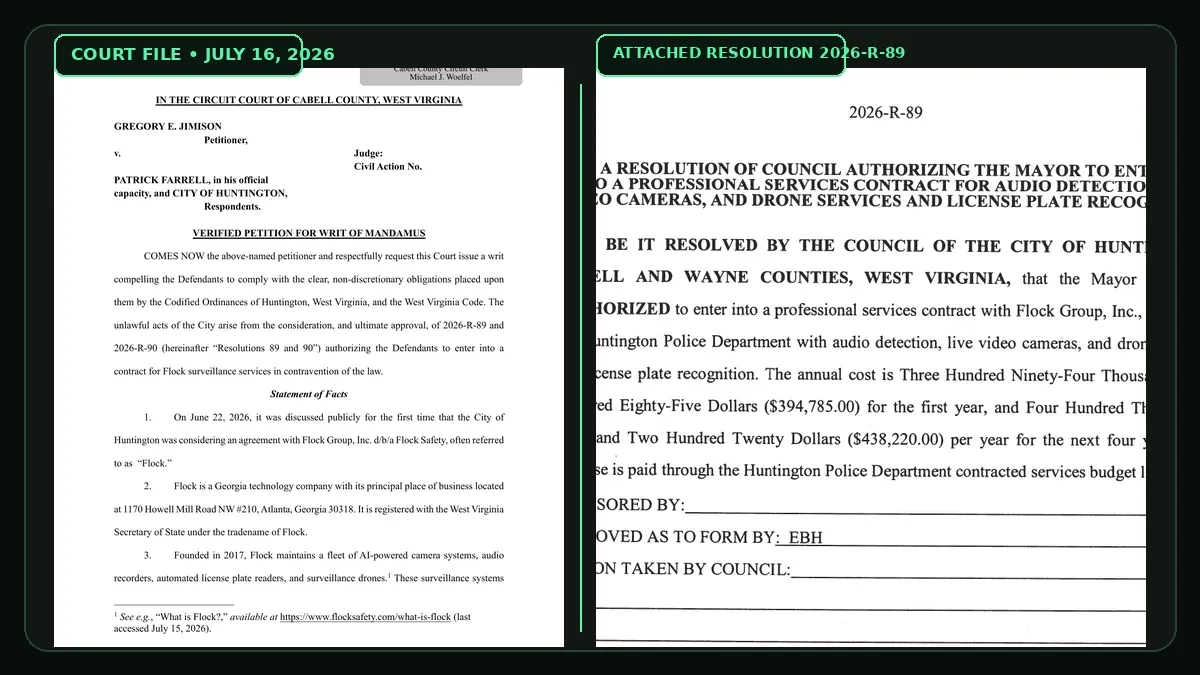
A Huntington resident has sued over the process used to approve a Flock Safety agreement. No judge has blocked the deal or found the city broke the law. But the 68-page court packet already shows what residents were being asked to accept: a five-year, multimodal surveillance service with durable vendor data rights and a vendor-controlled access door.
Huntington, West Virginia, did not vote on a few roadside cameras.
Resolution 2026-R-89 authorized the mayor to enter a professional-services contract covering license-plate recognition, live video, audio detection, and drone services. The price schedule attached to a new court filing lists $394,785 for year one and $438,220 for each of the next four years: $2,147,665 over five years.
The petition says city documents contemplated approximately 44 license-plate readers, 17 live-video cameras, audio recorders, and two drones. Those counts describe proposed scope in the plaintiff’s verified filing. They are not proof that the equipment has been installed, powered, or connected.
That distinction matters because the legal posture is brand new. Gregory Jimison filed a verified petition for a writ of mandamus in Cabell County Circuit Court on July 16. The suit argues that the city failed to follow required procedures for allowing a private company to use public property. It asks the court to compel compliance and invalidate the authorization.
Those are allegations and requested remedies. No responsive pleading, injunction, or merits ruling was located by Kyber’s July 17 research cutoff. The current petition is a procedural and public-property challenge, not a judicial finding that Flock’s technology violates privacy rights or the Fourth Amendment.
The lawsuit may be unresolved. The attached contract language is concrete.
The city “owns” Customer Data. Keep reading.
Section 4.1 of the Master Services Agreement attached to the petition starts with the sentence a city official would want to quote at a meeting:
“As between Flock and Customer, all right, title, and interest in and to Customer Data belong to and are retained by Customer.”
Then comes the rest of the bargain.
The customer grants Flock a “limited, non-exclusive, royalty-free, irrevocable, perpetual, worldwide license” to use and disclose Customer Data to provide the service and to use Customer Data to “support and improve Flock’s products and services.”
“Customer Data” is not defined as a narrow spreadsheet of plate numbers. Section 1.5 includes data captured through Flock’s services—images, audio, video, and associated metadata—plus content entered by authorized users and third-party information provided at the customer’s direction.
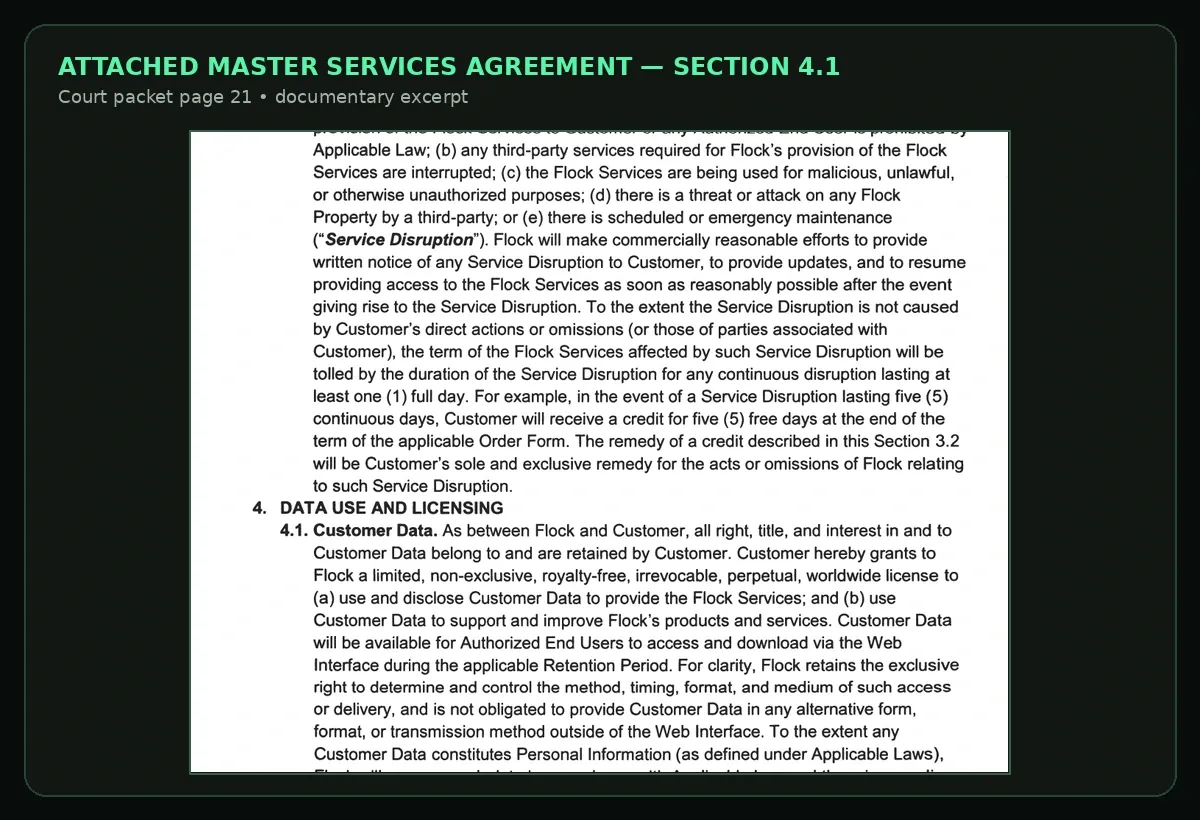
Documentary excerpt from the agreement attached to the July 16 court filing, PDF page 21. It has not been verified as the final executed agreement. The crop is limited to the clause under analysis; the full court packet is linked here.
This does not mean Flock keeps every frame of Huntington footage forever. A perpetual license and a source-data retention period are different things. The agreement defines the retention period as the time footage and associated metadata are stored, with the actual duration specified in an order form. Audit logs, exported evidence, backups, legal holds, aggregate data, and derived outputs may have different rules.
The filed paper does not settle those categories. Anyone claiming “all footage forever” is skipping the hard part.
The hard part is the data map: what gets captured, what gets derived, what can be shared, what can be exported, what survives deletion, and what the vendor can continue using after the city stops paying.
Ownership without a clean exit is rental with better stationery
The same clause says authorized users can access and download Customer Data through Flock’s web interface during the applicable retention period.
It then reserves for Flock “the exclusive right to determine and control the method, timing, format, and medium” of access or delivery. Flock is not obligated to provide Customer Data through an alternative method outside the web interface.
The agreement’s definition of “Flock Property” goes further. It includes derivative works, intermediate or final outputs, analyses, reports, models, and other results generated through the service. The customer gets a limited ability to access and download Customer Data during retention, but no general right to export those other elements.
That is an interface dependency, not proof of misconduct. There is no evidence in this filing that Huntington tried to export data and was refused. But the contract architecture matters before a failure, not after one. If a city cannot obtain complete records in an open, documented format, its practical ownership is narrower than the headline sentence suggests.
The agreement also says Flock may cut off web-interface access and remove its hardware if the customer defaults on payment. On termination or expiration, Flock will remove applicable hardware within a “commercially reasonable” period. The packet does not establish a fixed deprovisioning deadline, a complete export package, or a deletion certificate.
That is the SaaS model applied to public surveillance: taxpayers fund the system, the vendor runs the door, and the exit conditions live in definitions most people will never read.
The proposed stack is larger than ALPR
The city resolution covers four surveillance categories:
- license-plate recognition;
- live video cameras;
- audio detection;
- drone services.
The petition says city documents contemplated roughly 44 plate readers, 17 live-video cameras, audio recorders, and two drones. It also alleges that some devices would sit on city property or utility poles.
Again: proposed scope is not deployment status. Kyber did not verify a signed final agreement, notice to proceed, device inventory, installation record, active feed, or payment. A camera count in a filing does not prove a camera is collecting.
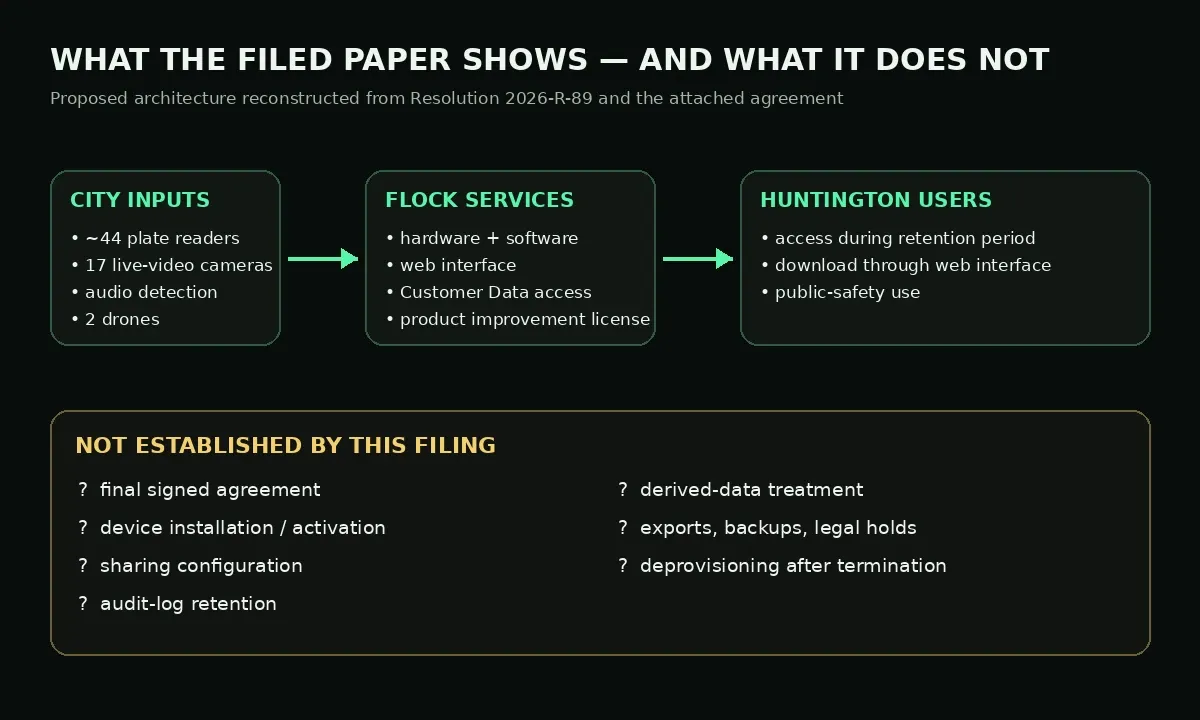
Kyber reconstruction from Resolution 2026-R-89 and the attached agreement. It is not a live network capture or device-location map. Unknowns are kept unknown rather than filled with surveillance fan fiction.
The unresolved questions are the story now:
- Was the agreement executed, and were its terms changed?
- Which devices are ordered, installed, powered, collecting, queryable, disabled, or removed?
- What are the retention periods for plate images, video, audio events, drone video, metadata, alerts, audit logs, and exports?
- Which outputs count as Customer Data, and which count as Flock Property?
- Can Huntington export a complete, usable archive in an open format?
- Which agencies can search or receive data, through which mechanism, and under whose approval?
- What happens to source data, derived outputs, models, backups, and legal holds when the relationship ends?
A press release cannot answer those questions. The executed contract, order forms, system configuration, audit records, and deprovisioning evidence can.
What the lawsuit actually says
The petition’s legal theory is narrower than the broader privacy fight.
It argues that Huntington’s ordinances and West Virginia law require specific procedures when a private company receives rights to use public property. The filing says the city did not use the required franchise, lease, hearing, notice, or fair-value process. It also alleges officials arranged smaller meetings to avoid a quorum.
No court has accepted those claims. The petition itself says possible substantive claims about operating the system are outside the present mandamus action.
That means the honest headline is not “court stops Flock” or “Huntington’s surveillance ruled illegal.” The honest headline is: a resident filed a procedural challenge, and the attached paper exposes a surveillance contract worth examining before implementation becomes a fact on the ground.
ACLU-WV, which represents the plaintiff with two private firms, says the city acted hastily and failed to follow its own rules. WV MetroNews reported Flock’s general position that it makes the systems while local governments decide the limits on their use.
That answer places more weight on the contract, not less. If local government sets the rules, the public needs the final rules: retention, sharing, audits, discipline, redress, export, deletion, and shutdown.
Kyber did not locate a city merits response, a responsive pleading, or a fresh Flock statement addressing the perpetual-license and interface clauses by the research cutoff.
The municipal surveillance contract checklist
Residents do not need to damage equipment or play hide-and-seek with cameras. They need paper, votes, logs, and enforceable limits.
Before a city activates a vendor-run surveillance system, demand these records:
Authority and implementation
- final executed agreement, every order form, amendment, implementation guide, and deployment plan;
- council resolution, procurement justification, legal review, purchase order, invoice, notice to proceed, and funding source;
- device-level status: ordered, installed, powered, collecting, queryable, disabled, or removed;
- pole, easement, attachment, lease, franchise, permit, and aviation records.
Data map
- source data for every sensor;
- metadata and inferred attributes;
- alert lists and watchlist sources;
- derived outputs, analytics, reports, and models;
- retention by category—not one vague “30-day” answer pasted over everything;
- audit-log retention, evidence exports, backups, legal holds, and deletion verification.
Access and sharing
- named user roles and permission levels;
- direct accounts versus customer-configured sharing;
- federated or network searches versus assistance by another agency;
- vendor support access;
- query reason, approval, audit, misuse discipline, and public reporting.
Exit and redress
- bulk export format and documentation;
- termination rights and cost;
- hardware-removal deadline;
- account deprovisioning;
- source-data deletion and treatment of derivatives;
- process for correcting a false alert or disputing improper use;
- independent audit rights and public complaint path.
If the city cannot answer those questions before activation, it has not bought public-safety equipment. It has rented a surveillance dependency with taxpayer money.
What readers can do now
Huntington residents can monitor the Cabell County docket for a response, show-cause order, hearing, temporary relief, dismissal, settlement, or merits ruling. They can request the signed instrument, implementation status, order forms, device inventory, pole agreements, invoices, retention settings, sharing configuration, user-role list, and audit policy under West Virginia’s public-records law.
City officials elsewhere can use the checklist before the vote. “The city owns the data” is not a complete answer. Ask who controls the interface, who owns derived outputs, what can be exported, what survives termination, and how the public proves the system was actually shut down.
For the wider capability question, read Kyber’s guide to vehicle fingerprinting beyond plate text. For the legal boundary around networked searches, read why the Supreme Court’s geofence ruling does not settle the ALPR question. And for communities weighing cancellation, read what camera removal does—and does not—prove.
The next decisive evidence will not be another corporate principles page or activist slogan. It will be the signed paper, the live configuration, the audit trail, and the records showing what happens if Huntington tries to leave.
Sources
- https://www.acluwv.org/app/uploads/2026/07/Filed-Petition-for-Mandamus-and-Petition-to-Show-Cause.pdf
- https://www.acluwv.org/press-releases/huntington-sued-following-approval-of-flock-contract/
- https://wvmetronews.com/2026/07/16/city-of-huntington-hit-with-lawsuit-from-aclu-others-over-2-1-million-flock-safety-contract/