Anoka’s Sheriff Priced a Flock-Drone Pilot Inside His Signing Limit
Anoka County’s sheriff says a $174,999 Flock camera and drone pilot was deliberately priced within his authority. The contract file still matters.
Anoka County Sheriff Brad Wise wanted a Flock camera and drone pilot. The larger route had run into political resistance. So, according to Wise’s own explanation reported by the Forest Lake Times, the final pilot was deliberately priced at $174,999—inside the authority he could exercise without a County Board award.
That is not a leak, a theory, or a mind-reading exercise. Wise said the amount was chosen so the pilot could move forward without legal trouble tied to the dollar value.
It is also not proof of an illegal purchase.
The county’s current procurement policy expressly gives the sheriff a path to authorize contracts within approved budgets, in consultation with the County Administrator, up to the administrator’s award ceiling. The accountability question is narrower and more useful: what exactly did the county buy, what approvals and competition supported it, what is the aggregate value, and what data system will exist when the pilot goes live?
The price opened the door. The contract file tells us what came through it.
What happened
Elliot Steeves of the Forest Lake Times reported on July 23 that Wise signed a $174,999 pilot combining drones and Flock automated license plate readers.
Wise said county law-enforcement leaders had worked on the proposal since fall 2025 and first took it to the County Board in January. The initial cost exceeded his contracting authority. He then described the route plainly:
“It became clear to me that the only way for this pilot to move forward with a test run was to work for a vendor to operate a contract that I could sign of under $175,000.”
The published quotation contains the awkward phrasing. The meaning is not hard to find. Wise also said the final price was set deliberately “to make sure there were no legal issues tied to the dollar amount.”
Commissioner Mandy Meisner objected to the process, not through a formal illegality finding but through a public statement quoted by the newspaper. She said the project should have remained in the county’s capital-planning process so finances, public input, privacy concerns and operating policies could be addressed before implementation.
That is the real conflict: delegated authority versus public review of a surveillance system. Government loves to call something a pilot when it wants the powers of a finished program with the scrutiny of a free trial.
The policy supports delegated authority—with conditions
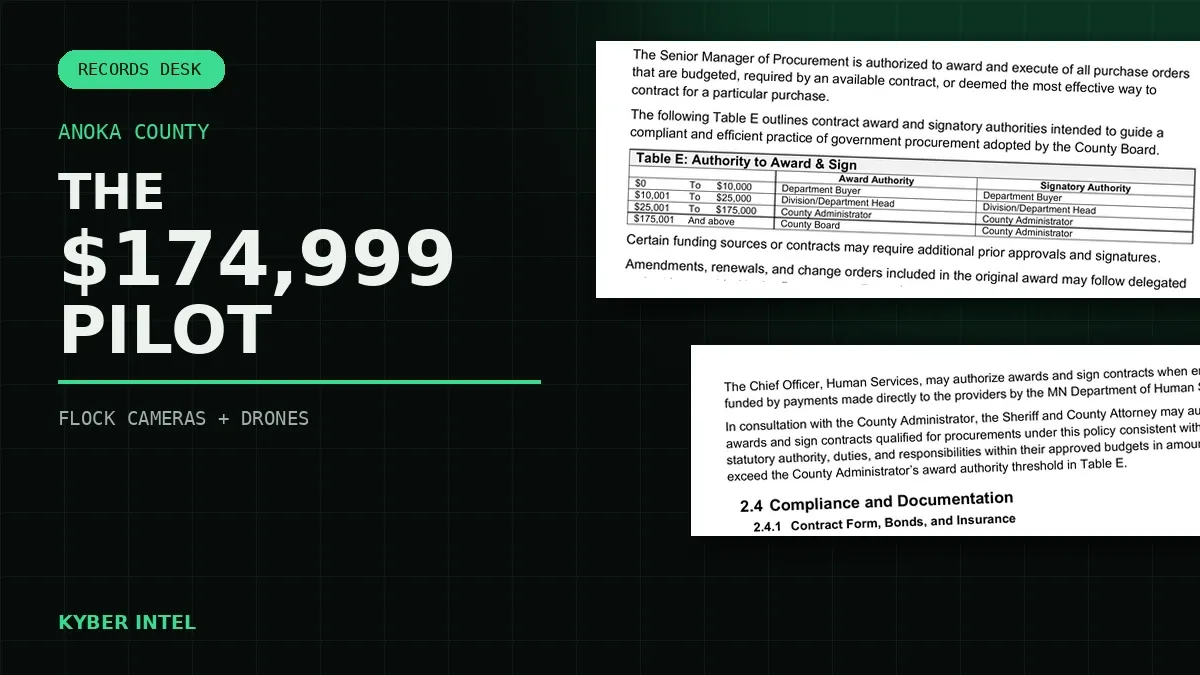
Anoka County’s current procurement policy places awards from $25,001 through $175,000 with the County Administrator. County Board award authority begins at $175,001.
The policy then gives the sheriff and county attorney a special delegation. In consultation with the administrator, they may authorize awards and sign qualifying contracts within approved budgets, up to the administrator’s threshold.
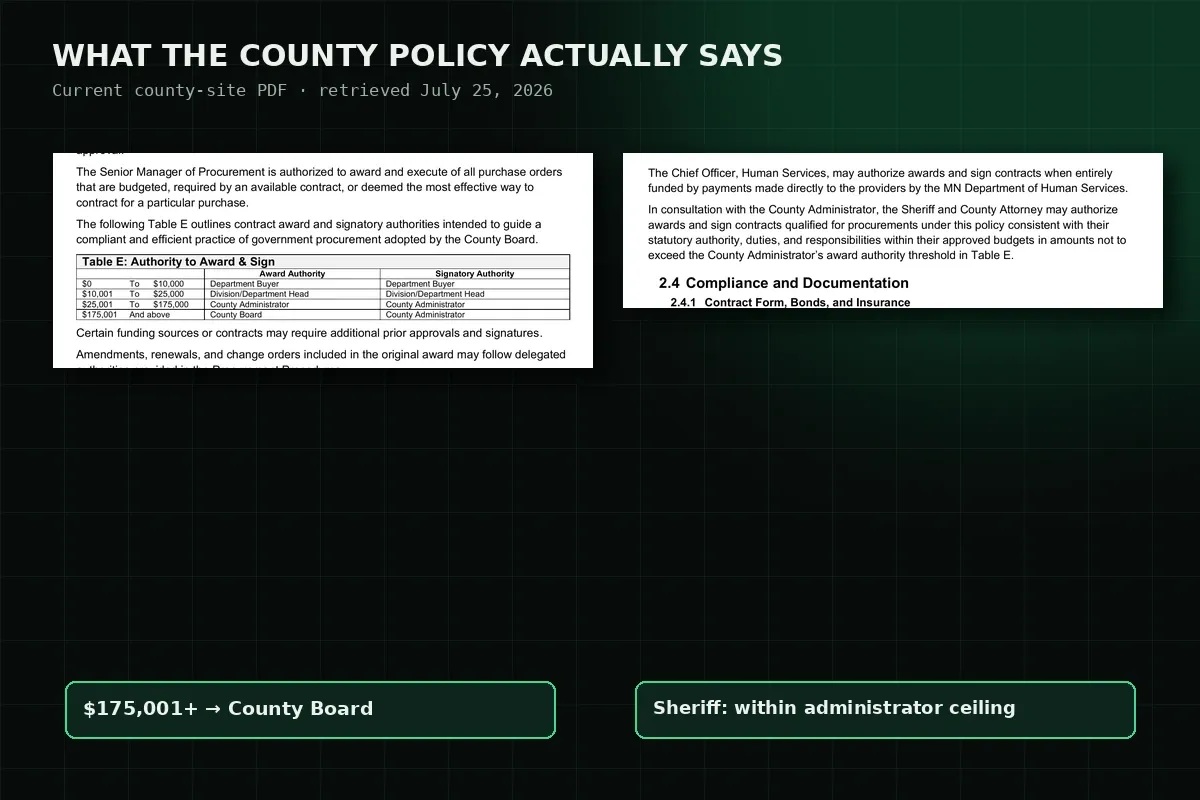
Source: Anoka County Procurement Policy, current county-site PDF retrieved July 25, 2026. Excerpts from Table E and the special-delegation section. The cover and revision history contain different adoption dates; that discrepancy does not change the quoted dollar bands.
This corrects one tempting but imprecise slogan. The contract was not literally “one dollar below the Board threshold” under the current Table E. A $175,000 award still sits in the administrator band; the Board band starts at $175,001.
The supported formulation is stronger because it is accurate: the $174,999 price was deliberately kept within the sheriff/administrator delegated ceiling after the larger proposal met resistance.
That does not answer whether every condition was satisfied.
The same policy says:
- the aggregate term, including renewal options, determines award and signing authority;
- purchases from $25,001 through $175,000 generally require competition;
- purchases may not be split to avoid competitive thresholds;
- technology purchases may require security review;
- written contracts and amendments require specified legal and procurement handling;
- the county must preserve enough records to show the procurement’s process and decision history.
Those provisions are not evidence that Anoka split a purchase, skipped competition or broke the law. They are a records checklist. The executed agreement, order forms, pricing history, competition or exemption record, budget source, administrator consultation and aggregate-value calculation were not available in the source package Kyber reviewed.
The missing file is the story
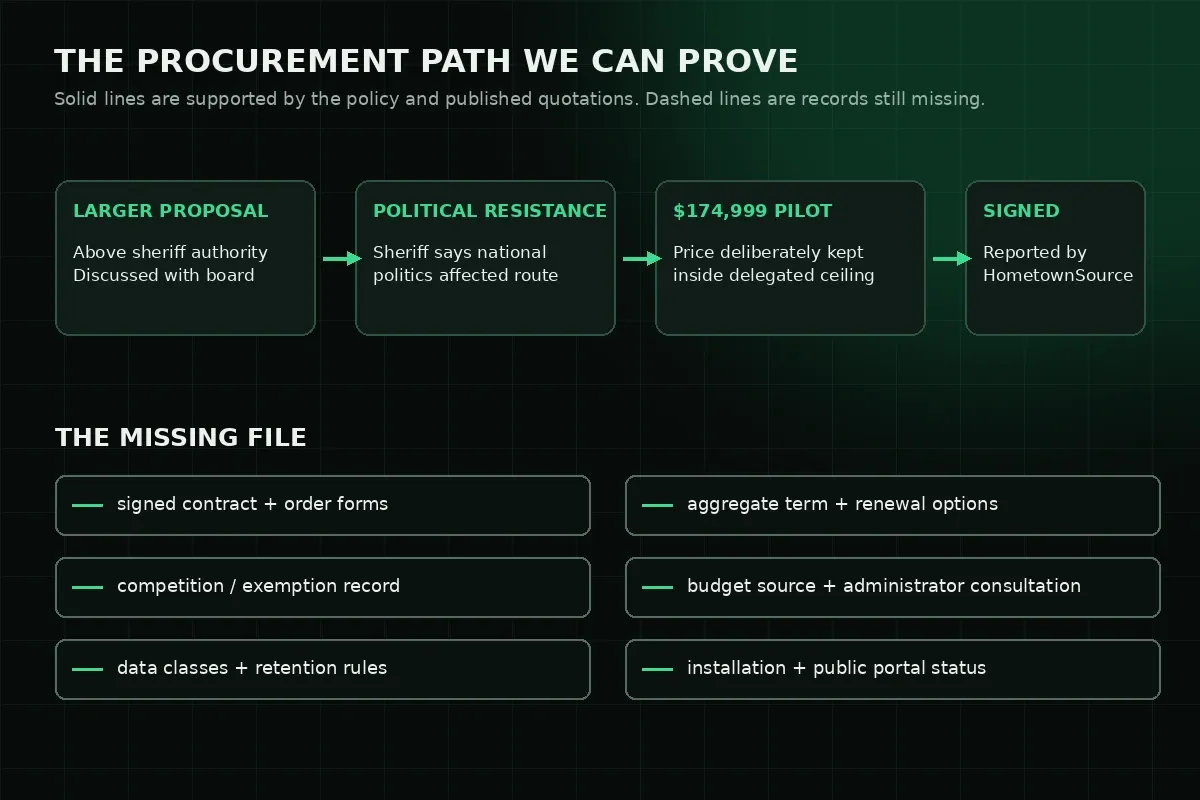
Kyber reconstruction from Wise’s attributed statements and the county policy. It does not allege unlawful purchase splitting. Dashed questions remain unverified until the procurement file is public.
A $174,999 cover price can hide very different deals.
A one-year pilot with no renewal may stay inside the delegated band. A contract with options, extensions, required follow-on services or separate orders can carry a different aggregate value. A competitively sourced cooperative contract presents a different process from a sole-source award. A drone package dominated by hardware presents different data risks from a managed service tied into Flock’s hosted network.
Without the agreement, “pilot” is branding.
The file should show at least:
- the signed contract, order forms and statement of work;
- the initial term, every renewal option and total potential value;
- line-item revisions showing how the larger proposal became $174,999;
- the competitive process, cooperative contract or approved exception;
- administrator consultation, budget coding and legal/security review;
- the number and type of cameras and drones, installation schedule and participating cities;
- every data class, access role, retention period, export path and partner-sharing route;
- the promised public portal and the records it will actually expose.
If those documents confirm a limited, properly sourced, reversible pilot, the county can demonstrate that. If they reveal a larger option stack or vague data controls, the public gets to see that too. Auditability should not depend on trusting the same office that wanted the system.
“Thirty days” is not a data map
Wise told the newspaper that Flock cameras would store still images for 30 days before automatic deletion. That is a specific public representation. It is not a universal retention guarantee.
A surveillance program can produce multiple objects:
- source still images;
- plate reads and vehicle descriptors;
- searches and candidate results;
- hot-list alerts;
- user and audit logs;
- exported evidence;
- shared copies;
- drone video and flight telemetry;
- backups, legal holds and vendor-support records.
A 30-day setting for still images says nothing by itself about the rest. Anyone who has watched a corporate privacy policy perform interpretive dance around the word “data” should recognize the move.
Wise also said cities could opt out, camera locations would be public, Columbia Heights had opted out, and no pilot cameras would be installed there. He promised an online portal showing drone activity. Those are useful commitments. They remain implementation claims until location records, account settings, deprovisioning records and the live portal can be checked.
“Columbia Heights gets no new camera” is not the same claim as “Columbia Heights residents cannot appear in partner searches, existing systems or historical exports.” Each access path needs its own answer.
The vendor and agency position
Wise frames the pilot as a public-safety test. He says Flock cameras are not new to the county, cities retain sovereignty through an opt-out, camera locations will be public, still images will delete after 30 days, and the sheriff’s office is not trying to create a surveillance state.
He also argues that body-camera footage and police-report systems hold more intimate data but attract less scrutiny.
That comparison supports more scrutiny of those systems, not less scrutiny of Flock and drones. “We already have other sensitive databases” is not a privacy control. It is an inventory problem.
Meisner’s response is procedural: she wanted financial review, public engagement and clear policies before implementation. Nothing in the source record reviewed here establishes that the contract is unlawful, that the system is active, or that any camera or drone has been misused.
What Anoka residents can do now
No sabotage. No camera cosplay. Use the records trail the county’s own policy says should exist.
Request the procurement history
Ask for the executed contract, proposals, price revisions, order forms, renewals, administrator consultation, budget records, competition documents, exceptions, security review and legal approval. Ask for native electronic files and attachments, not only a flattened summary.
Demand a retention table by data object
Do not ask, “How long do you keep the data?” Ask separately about stills, plate records, searches, alerts, hot lists, audit logs, exports, drone video, telemetry, backups, partner copies and legal holds.
Track implementation, not promises
Record installation dates, participating cities, opt-outs, the public camera map, the drone portal, account rosters and sharing partners. A policy on launch day is not proof of how a system is configured six months later.
Put the renewal date on the calendar
A pilot is easiest to scrutinize before it quietly becomes infrastructure. The contract’s notice, renewal and termination dates should become public deadlines, not procurement trivia discovered after the option rolls over.
For the larger architecture problem, read Kyber’s Huntington Flock contract autopsy and the legal limits of treating an ALPR query like a proven identification.
Evidence boundary
Proven from the current record: HometownSource reports that Wise signed a $174,999 Flock/drone pilot; Wise said the price was deliberately structured within his authority after political resistance affected the larger route; the current county policy places $175,000 inside the administrator band, begins Board authority at $175,001, and specially delegates the sheriff within that ceiling under stated conditions.
Not proven: unlawful splitting, bid evasion, noncompliance, total aggregate value, the operative contract terms, completed deployment, actual deletion, partner-access scope, or misuse.
The next honest headline belongs to the contract.