The Poles Were Never the Whole Product
Flock pitched ~350k Uber/Lyft/delivery dashcams via Nexar to Georgia’s AG office. The partnership was never executed. The mobile plate-graph roadmap is still the story.
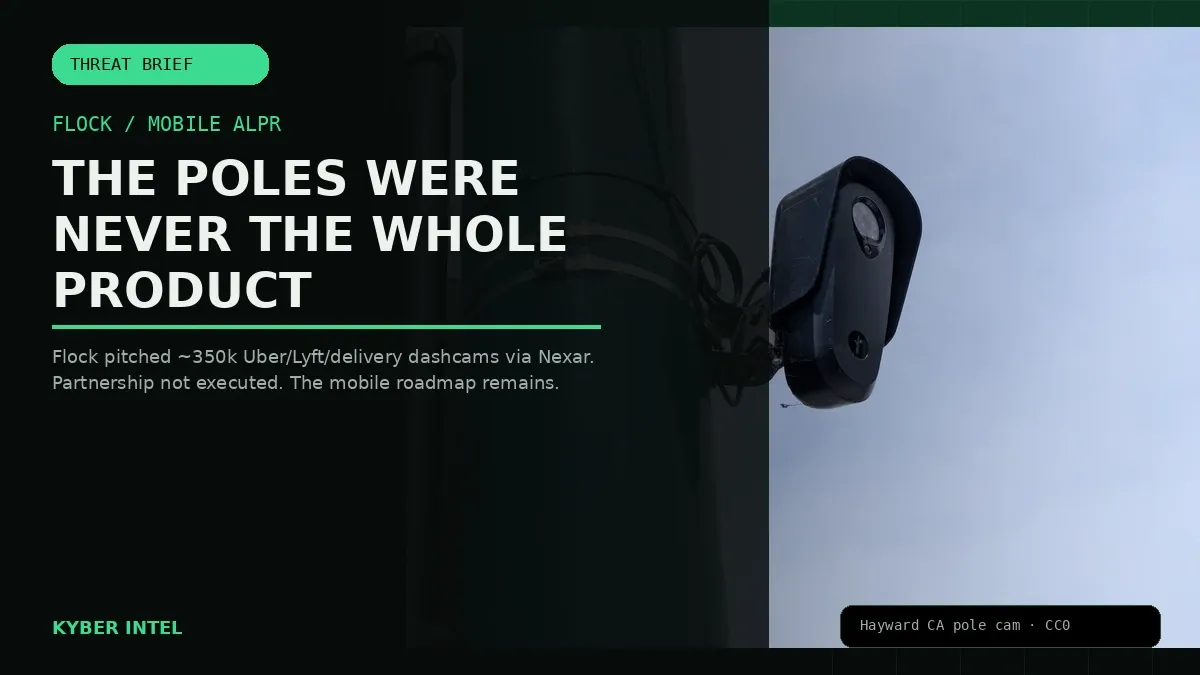
The public fight about automatic license plate readers is still mostly about poles.
Poles are easy to photograph. Poles show up in city council packets. Poles get cut down, debated, and replaced.
A Flock presentation written for the Georgia Office of the Attorney General — obtained by a Dunwoody resident through a public records request and published by 404 Media on August 7, 2026 — points somewhere colder.
Flock did not only pitch more poles. It pitched ordinary commercial drivers as roaming collection nodes.
Evidence boundary
Publication-ready:
- Flock presentation language as published by Joseph Cox at 404 Media (August 7, 2026), from a document obtained by Jason Hunyar via public records and written for the Georgia Office of the Attorney General “last August.”
- Exact published blend: commercial businesses and HOAs in Georgia “are part of the network,” plus “Nexar partnership which includes 350k Uber/Lyft and other delivery service devices.”
- Flock’s email response, as reported by 404: it never executed the partnership with Nexar.
- 404’s report that Uber, Lyft, and Nexar did not respond to requests for comment.
- Nexar first-party marketing captured August 7, 2026 from getnexar.com: “Trusted by 350,000+ drivers,” “350K+ Connected cameras,” rideshare/fleet marketing, and Road Safety copy that blurs faces, license plates, and pedestrians on-device with an in-app opt-out path.
- Nexar Privacy Policy (page stamp: September 2025) defining users to include rideshare/fleet drivers and describing legal-obligation disclosures.
- Flock first-party product/trust surface captured the same day from flocksafety.com and Trust.
- Parallel mobile patterns as reported by 404 in the same article (Axon vehicle mounts; Motorola Vigilant/DRN repo-car collection; BusPatrol school-bus ALPR plans) and the lede only of 404’s August 6 piece on cities ditching Flock for Axon.
Not established / do not upgrade:
- That ~350,000 rideshare or delivery dashcams currently feed Flock. Pitch language + marketing figure, not a live audited census.
- That Uber or Lyft contracted for, approved, or even knew about plate ingestion for law-enforcement partners.
- That any specific driver consented to becoming an ALPR node.
- That Kyber holds the underlying Georgia OAG PDF. This package relies on 404’s published excerpts and screenshot provenance until the raw record is locked.
- The exact current Nexar product-page string “clear license plate capture with Full HD video” as independently re-verified in today’s plain-text homepage capture; attribute that phrasing to 404’s website citation unless a product page locks it.
- Axon replacement city lists, contract terms, or body claims beyond 404’s free lede (“a handful of cities”).
- Roseville’s ~71% alert misread figure as a national OCR score. Sidebar only, with the same limits as Kyber’s August 5 package.
The thesis, tight
Flock’s control product is a multi-modal movement graph.
- Fixed poles are the public face.
- HOA and commercial cameras are the quiet density layer.
- Consumer and fleet mobile sensors are the scale strategy — even when one partnership dies under scrutiny.
If your city only debates pole count, you are negotiating with the brochure.
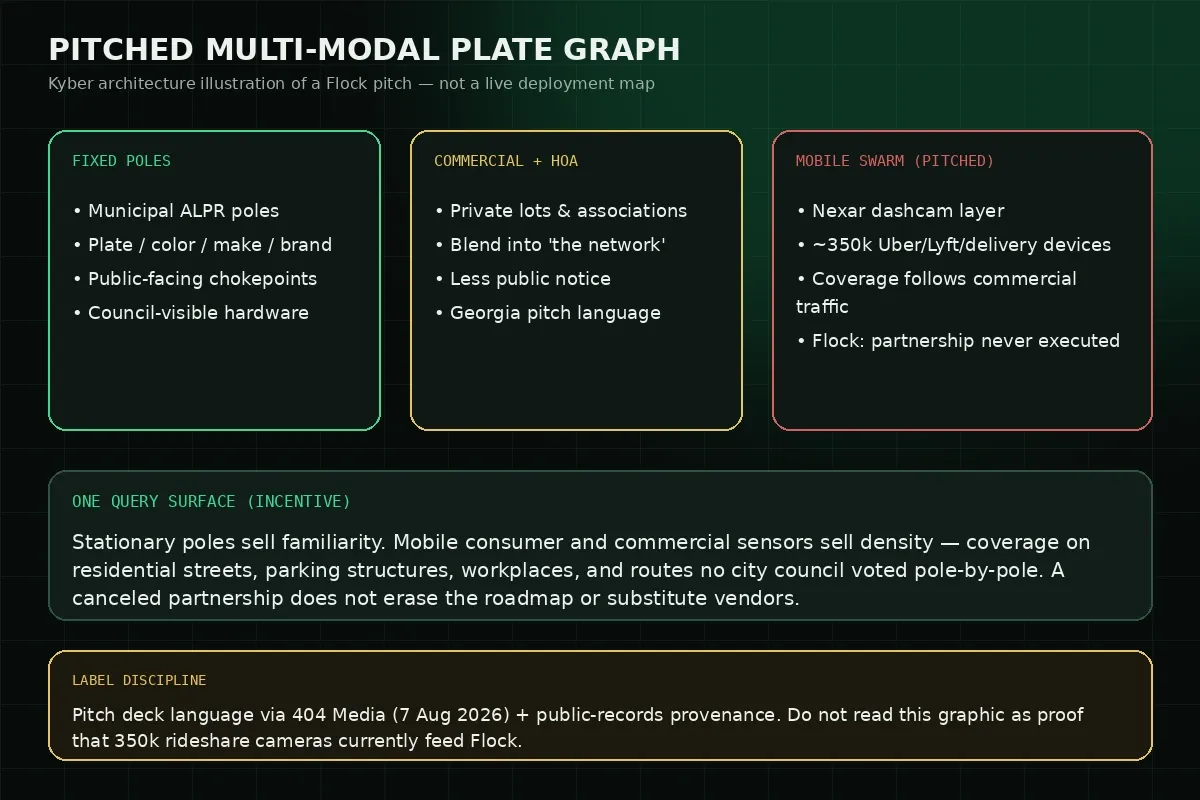
Kyber architecture illustration of a pitched multi-modal plate graph. Not a live deployment map. Source language: Flock Georgia OAG presentation as published by 404 Media, August 7, 2026.
What the pitch actually said
404 Media’s Joseph Cox published the document chain on August 7. A Dunwoody, Georgia resident, Jason Hunyar, pulled a Flock presentation through a public records request and shared it. The presentation was written for the Georgia Office of the Attorney General last August — around the same window 404 first reported an intended Nexar partnership from sources.
The published lines are not subtle:
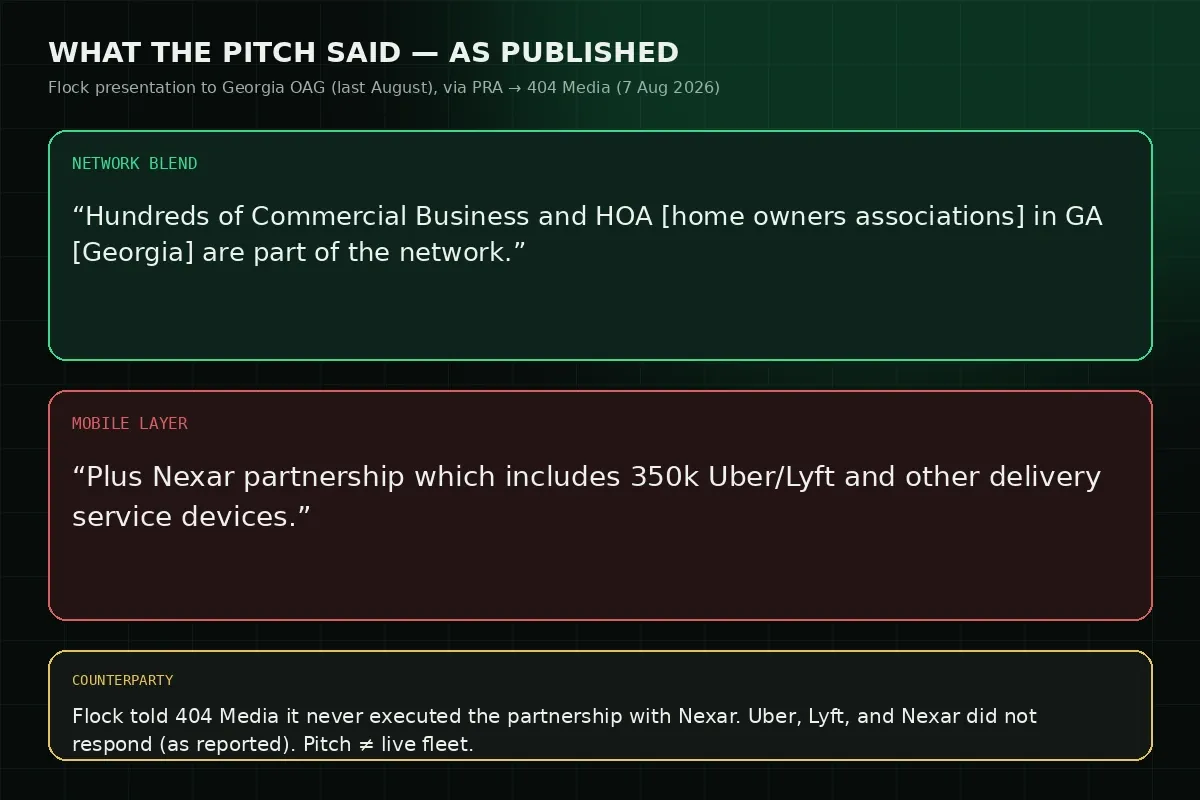
Quote card built from presentation language as published by 404 Media (August 7, 2026), public-records provenance via Jason Hunyar. Not a scan of a raw PDF held by Kyber. Includes Flock’s reported “never executed” response.
Compressed:
- Commercial businesses and HOAs in Georgia are already framed as “part of the network.”
- The mobile add-on is explicit: Nexar partnership, 350k Uber/Lyft and other delivery service devices.
- Stationary poles capture plate, color, make, and brand of vehicles that pass. The Nexar layer, in 404’s reading, would have made collection mobile.
Then the necessary counterparty sentence, which Kyber will not bury:
Flock told 404 it never executed the partnership with Nexar.
That matters. A pitch is not a production feed. A canceled deal is still a confession of intent. Procurement audiences were being sold density that ordinary residents never get to vote on pole-by-pole.
404 also notes the consent fog: it is not clear whether Uber, Lyft, or drivers would have known. Uber, Lyft, and Nexar did not respond to 404.
Why mobile collection is a different animal
Fixed ALPRs create chokepoint graphs: intersections, exits, corridors, the places a city is willing to put steel in the ground.
Driver-mounted cameras create coverage wherever commercial traffic already goes — residential streets, apartment lots, workplaces, clinics, protests, school pickup lines — without a separate siting fight for each node.
That is the incentive. Not civil-liberties minimization. Density and novelty for the buyer:
- “We already have hundreds of commercial/HOA nodes.”
- “Plus hundreds of thousands of mobile devices.”
Flock’s public site still sells the friendly stack: National LPR Network, cross-agency visibility, “every search is logged and reviewable,” HOA and business verticals beside public sector. Logging is real product surface. Logging is not the same thing as democratic authorization of every sensor class feeding the graph.
The consumer dashcam story is not the police story
Nexar is a real consumer and fleet dashcam vendor. Kyber’s August 7 capture of getnexar.com shows the company marketing itself as more than a camera: connected devices, cloud backup, rideshare and fleet fit, and a “Road Safety” network narrative.
On the consumer path Nexar advertises:
- faces, license plates, and pedestrians blurred on-device before road data leaves the camera;
- contribution on by default;
- opt-out under Settings → Privacy → Road Safety;
- a privacy policy that already contemplates rideshare/fleet users and disclosures for legal obligations.
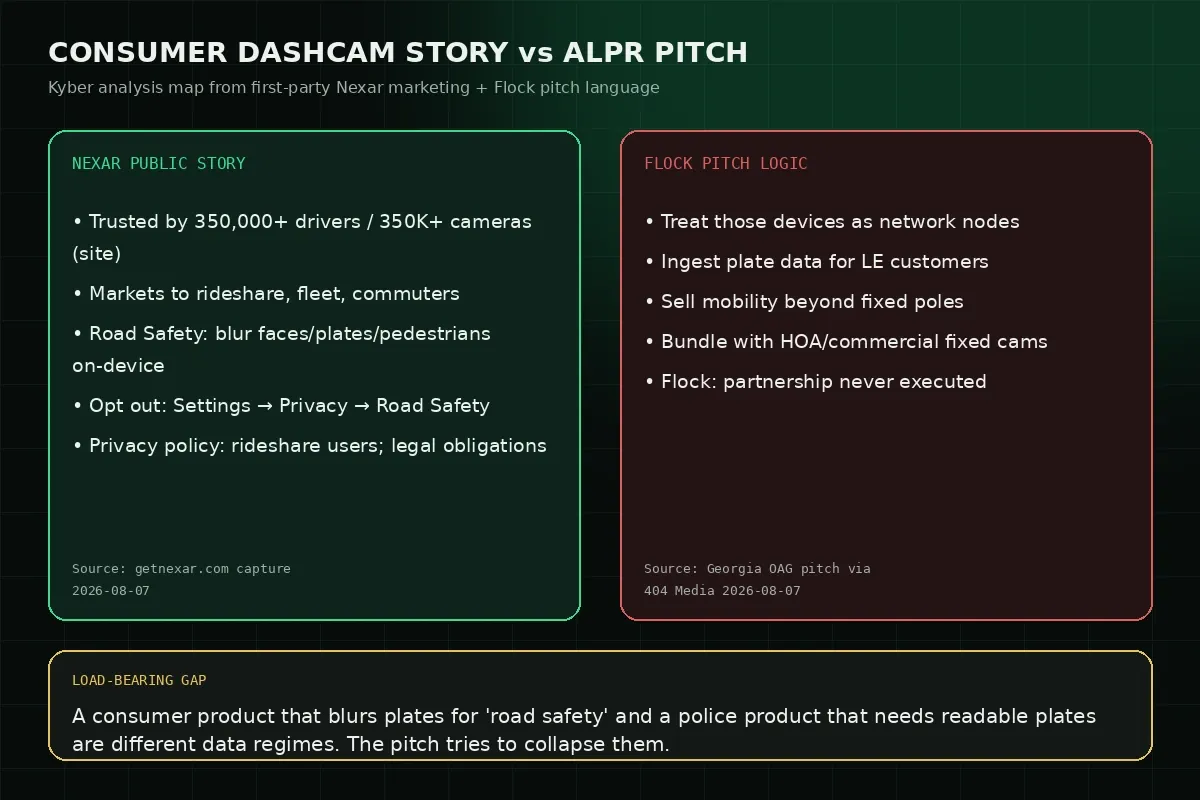
Kyber analysis map. Left: Nexar first-party marketing and privacy themes captured August 7, 2026. Right: Flock pitch logic as published by 404. Not an official Nexar or Flock exhibit.
Hold those two stories next to each other.
A consumer product that markets plate blur for road-safety analytics and a police product that needs readable plates are different data regimes. A law-enforcement partnership is not a minor skin on the same pipeline. It is a rights and purpose rewrite — of drivers, passengers, and everyone else the camera happens to see.
404 also reminds readers that Nexar already suffered a serious breach in prior reporting: a hacker accessed terabytes of customer video, including near sensitive Department of Defense locations. Historical security failure is not proof of a current Flock feed. It is proof that consumer dashcam clouds are high-value targets even before you bolt them to a police query UI.
Mobile is already an industry pattern
Even without Nexar, the industry is not pole-only:
- Axon sells ALPR form factors for patrol vehicles and, per 404’s August 6 lede, streetlamp-blend mounts that cities install when they ditch Flock without ditching ALPR.
- Motorola’s Vigilant / Digital Recognition Network path has long used cameras on repossession and other private vehicles.
- BusPatrol, per 404’s May reporting cited in the August 7 piece, has planned to turn large school-bus camera fleets into ALPR access for law enforcement.
Read that list as architecture, not vibes. If one consumer partnership dies, the product category does not. “We canceled Flock” can still mean “we bought Axon,” which is cancellation theater unless the ordinance bans the function.
Accuracy sidebar: density multiplies error
Kyber already covered the Roseville accuracy package in Do Not Mention the Hit. The short version belongs here because mobile expansion without honest failure metrics is how bad OCR becomes a roaming harassment lottery.
As reported by Techdirt (August 6, 2026) synthesizing Business Insider’s records work, and by CNET (August 4, 2026):
- Roseville PD reviewed Flock stolen/felony-style alerts in a 2023–2024 window (Techdirt: 1,427 alerts; CNET: nearly 1,500 reports).
- Analysis found about 71% involved incorrect plate reads.
- Flock points to a “particularly unique” / “wasn’t typical” deployment: rear-only capture to avoid faces, older hardware, higher/farther mounts; claims later improvement that the PD disputed in Techdirt’s account.
- Marketing figures about high character accuracy under optimal conditions are not the same metric as full-plate correctness on hot-list alerts in the field.
Do not upgrade 71% into “Flock is wrong seven times out of ten everywhere.” Do not ignore it either. A vendor pitching hundreds of thousands of roaming nodes while a municipal customer documents majority-wrong hot-list alerts is selling ambition harder than reliability.
Vendor and agency position
| Party | What they said / what is on the record |
|---|---|
| Flock | Never executed the Nexar partnership (email to 404, reported Aug 7). Public site continues to sell networked LPR, audit-ready search logging, and HOA/business + public-sector products. On Roseville accuracy: unique/non-typical setup; performance improved (disputed). |
| Nexar | No comment to 404 as reported. Public site markets a large connected-camera fleet, rideshare use, on-device blur for Road Safety contribution, and legal-obligation disclosure paths in policy. |
| Uber / Lyft | No comment to 404 as reported. No first-party policy on law-enforcement plate graphs from rideshare dashcams locked in this package. |
| Georgia OAG | Presentation recipient per 404. No OAG statement captured here on whether any evaluation or pilot followed. |
What this is really for
The brochure argument is crime reduction.
The architecture argument is coverage without consent theater.
Poles require siting. Mobile consumer sensors ride inside traffic that already has a commercial reason to enter your street. HOA and retail cameras soft-launch the same network under private property aesthetics. The query UI does not care which class produced the hit — unless the contract forces it to say so, and the audit log stores the source class, and the public can see the difference.
That is why “we never executed Nexar” is not the end of the story. It is the beginning of the contract fight.
Practical exits — lawful response only
This is not a guide to sabotaging cameras, spoofing plates, or interfering with drivers. It is a checklist for people who still believe public power needs public rules.
If you sit on a council, board, or oversight body
- Ban source classes by name unless separately authorized by ordinance: rideshare/delivery/consumer dashcam plate ingestion; HOA/commercial third-party feeds without public notice; school-bus ALPR access; repo-car or other private-fleet ALPR without disclosure.
- Force a public data-source schedule in the contract and a quarterly transparency report: fixed municipal, agency vehicle, HOA, retail, consumer mobile, school bus, other.
- Require audit-log fields for every query and hit: operator, purpose, source class, camera ID class, retention clock, export/share events.
- Accuracy clauses: publish monthly true-alert / false-alert / human-verified-stop metrics; termination rights for sustained false-alert thresholds; independent testing rights (no vendor blacklist of testers).
- Human verification before stops is a mitigation, not a privacy cure. Write it down anyway.
- Cancellation ≠ exit. If you drop Flock, ban replacement ALPR functions or you will buy Axon with better camouflage. See Kyber’s deprovisioning brief: De-Flock Is the Easy Part.
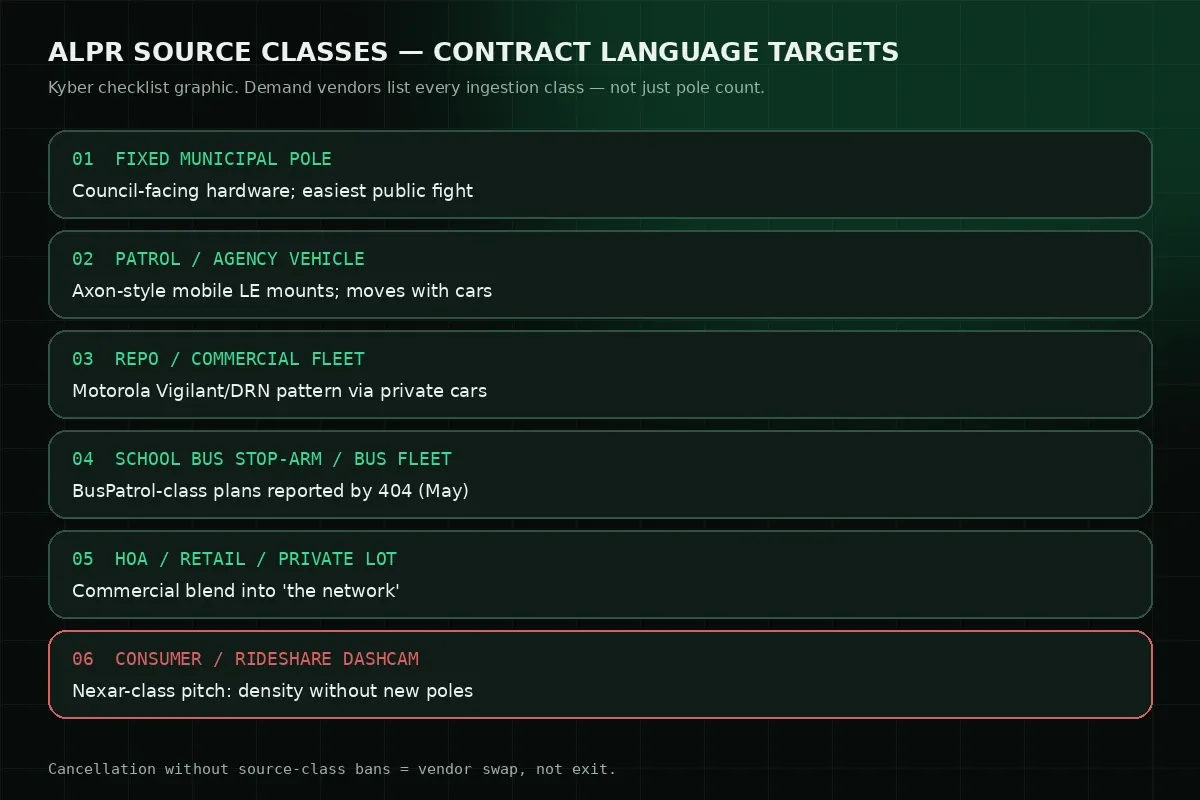
Kyber contract-language target list. Analysis graphic, not a vendor interface. Cancellation without source-class bans is a vendor swap.
If you file records requests
Ask for more than “the Flock contract”:
- any presentation, pilot, RFP, or evaluation involving third-party mobile, Nexar, rideshare, delivery, HOA, or consumer dashcam data;
- order forms and exhibits listing subprocessors and data sources;
- hit/export logs that identify source class, not only plate and time;
- accuracy audits, false-alert counts, and vendor remediation emails;
- policies on what deputies may say about ALPR to drivers and in reports (secrecy SOPs are part of the product culture — see Do Not Mention the Hit).
If you drive for apps or mount a consumer dashcam
- Read the dashcam vendor’s law-enforcement and “legal obligation” language, not only the blur marketing.
- Assume multi-party recording: drivers, passengers, pedestrians, nearby plates.
- This is a notice and labor/political accountability problem. It is not a prompt to disable safety equipment required by an employer or to break platform rules.
If you just live here
- Track whether your city buys functions (networked plate graph) or brands (Flock vs Axon).
- Demand public maps and source-class disclosures, not vanity dashboards.
- Support targeted warrants and due process for actual crimes. Reject the slide that says the only alternative to a roaming commercial sensor swarm is chaos.
What Kyber is watching next
- The raw Georgia OAG presentation PDF and any attachments.
- Whether Georgia or other states ran evaluations that included mobile third-party collection.
- Municipal contract clauses that already silently allow “partner” or “ecosystem” data sources.
- Uber/Lyft written policies on fleet dashcams performing plate capture for police partners.
- Nexar statements on past or present ALPR/law-enforcement agreements.
- Axon replacement contracts in cities that “got rid of Flock.”
- Accuracy audits that survive contact with rear-only, night, rain, and non-lab mounts.
Bottom line
The pole was always the friendly object.
The product is a movement graph that wants every commercially convenient camera — HOA, retail, school bus, patrol car, repo car, and, if the pitch had landed, the rideshare driver who thinks they bought a dashcam for insurance clips.
Flock says the Nexar deal never executed. Good. Write the ban anyway. Roadmaps outlive press cycles, and the next vendor will not need your permission to reuse the architecture if your contract only names one brand.
Sources
- https://www.404media.co/flock-pitched-a-plan-to-turn-uber-and-lyft-drivers-into-roaming-surveillance-vehicles/
- https://www.getnexar.com/
- https://www.getnexar.com/privacy
- https://www.flocksafety.com/
- https://www.flocksafety.com/trust
- https://www.404media.co/cities-are-ditching-flock-immediately-replacing-it-with-axon-license-plate-readers/
- https://www.techdirt.com/2026/08/06/california-town-says-flock-cameras-misread-license-plates-71-of-the-time/
- https://www.cnet.com/home/security/flocks-ai-cameras-may-have-misread-over-70-of-license-plates/
- https://kyberintel.com/blog/do-not-mention-the-hit/
- https://kyberintel.com/blog/de-flock-is-the-easy-part-deprovisioning-is-the-story/
- https://kyberintel.com/blog/the-cameras-are-watching-now-people-are-cutting-them-down/
- https://kyberintel.com/blog/huntington-authorized-a-2-1-million-surveillance-stack-the-data-door-stays-behind-flocks-interface/