Do Not Mention the Hit
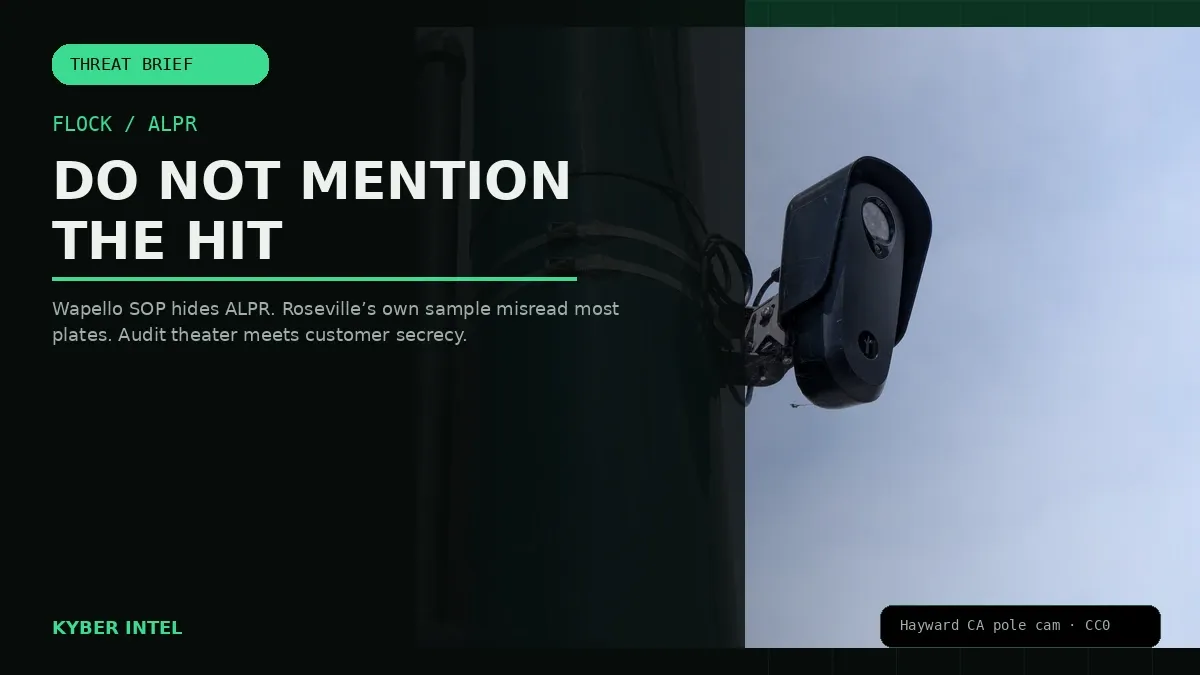
A Iowa county SOP tells deputies not to mention Flock ALPR usage. Roseville’s own sample misread most plates. Flock still sells reviewable searches. That gap is the product.
Flock Safety’s public website sells a comforting stack: local control, audit logs, reviewable searches, compliance tools. In the same week, two receipts hit from different layers of the same machine.
One is a customer policy that tells deputies to hide the method. The other is a municipal accuracy sample that says the method misreads plates most of the time.
That is not a vibes argument. It is a product argument.
Evidence boundary
Publication-ready:
- Wapello County, Iowa Flock standard operating procedures language as published by 404 Media on August 4, 2026, from a November 2025 SOP obtained by a reader via public records request.
- Named response from Sheriff Don Phillips in that piece.
- Flock first-party trust and marketing copy captured from flocksafety.com, including Trust, Privacy & Ethics, Data Privacy, and Compliance Tools pages on August 5, 2026.
- CNET’s August 4, 2026 report that Roseville, California police analyzed nearly 1,500 Flock reports and found a ~71% plate misread / failure rate in a 2023–2024 window, plus Flock’s “wasn’t typical” response as reported.
Not established / do not upgrade:
- That Flock corporate HQ wrote or required the Wapello secrecy SOP. This is one county’s customer policy.
- That ~71% is Flock’s current national plate-OCR accuracy. It is a reported municipal sample with a dated window.
- The underlying Roseville PD memo text, methodology footnotes, or council packet. Kyber has not locked that primary in this package.
- Local headlines about “no wrongful stops” or “keep the cameras” beyond what CNET itself supports. Treat other outlets as leads until their bodies and primary packets lock.
- Reynoldsburg personnel allegations, Burnet damage-driven removals, or Elk Grove sharing-audit figures. Out of scope here.
- That audit logs equal real-time public oversight, or that a logged search prevented misuse.
The thesis, tight
The ALPR fight is not “cameras versus crime.” It is three stacked products:
- a federated plate graph sold city by city;
- a customer secrecy culture that can launder the hit as “county resources”;
- an OCR reliability problem that turns wrong digits into police attention.
If the handbook says hide the graph, “transparency portal” is a brochure. If the sample misreads seven plates in ten, the graph is also a harassment lottery—even when a deputy is told to “verify” before acting.
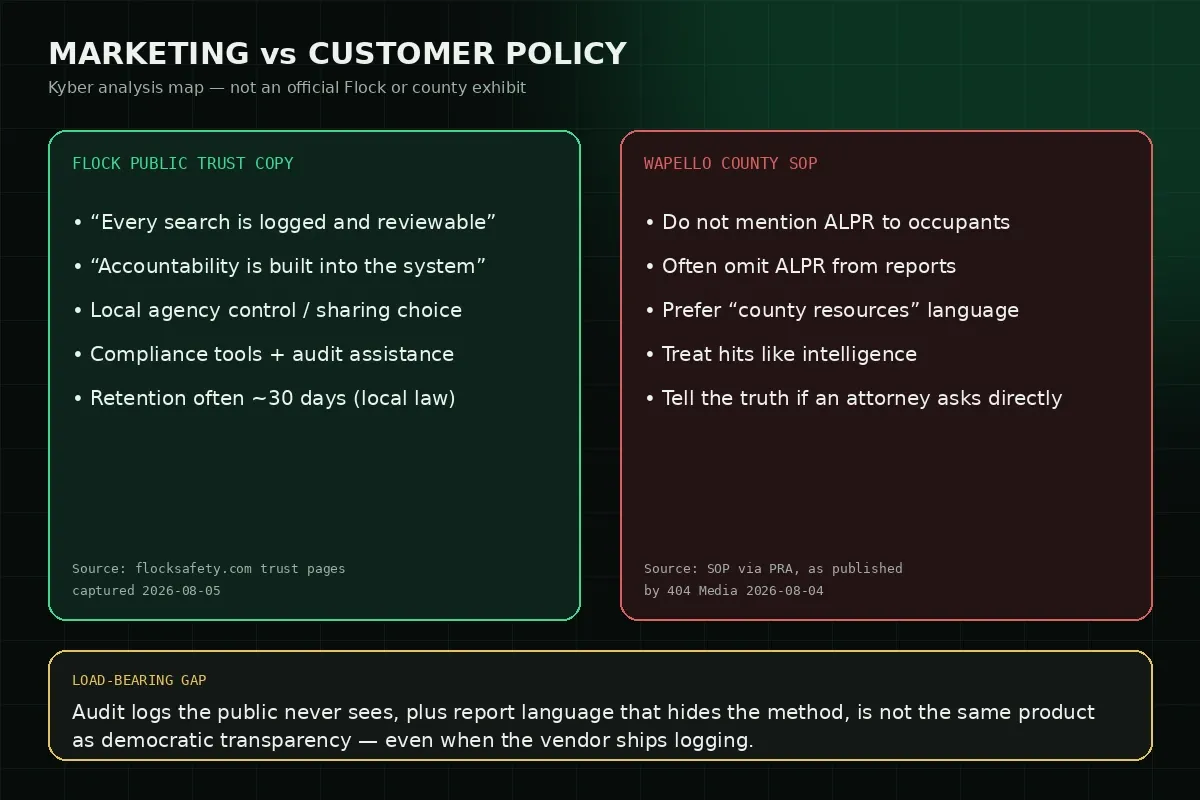
Kyber analysis map. Left column summarizes Flock first-party trust/marketing themes captured August 5, 2026. Right column summarizes Wapello SOP instructions as published by 404 Media. Not an official Flock or county exhibit.
Layer one — the customer handbook says shut up about the camera
Jason Koebler at 404 Media published the Wapello County Flock SOP on August 4. The document is dated November 2025. A reader pulled it with a public records request and shared it. The county, per 404, runs four Flock cameras under a late-2024 contract. Ottumwa is the largest city in the county.
The quoted instructions are not subtle:
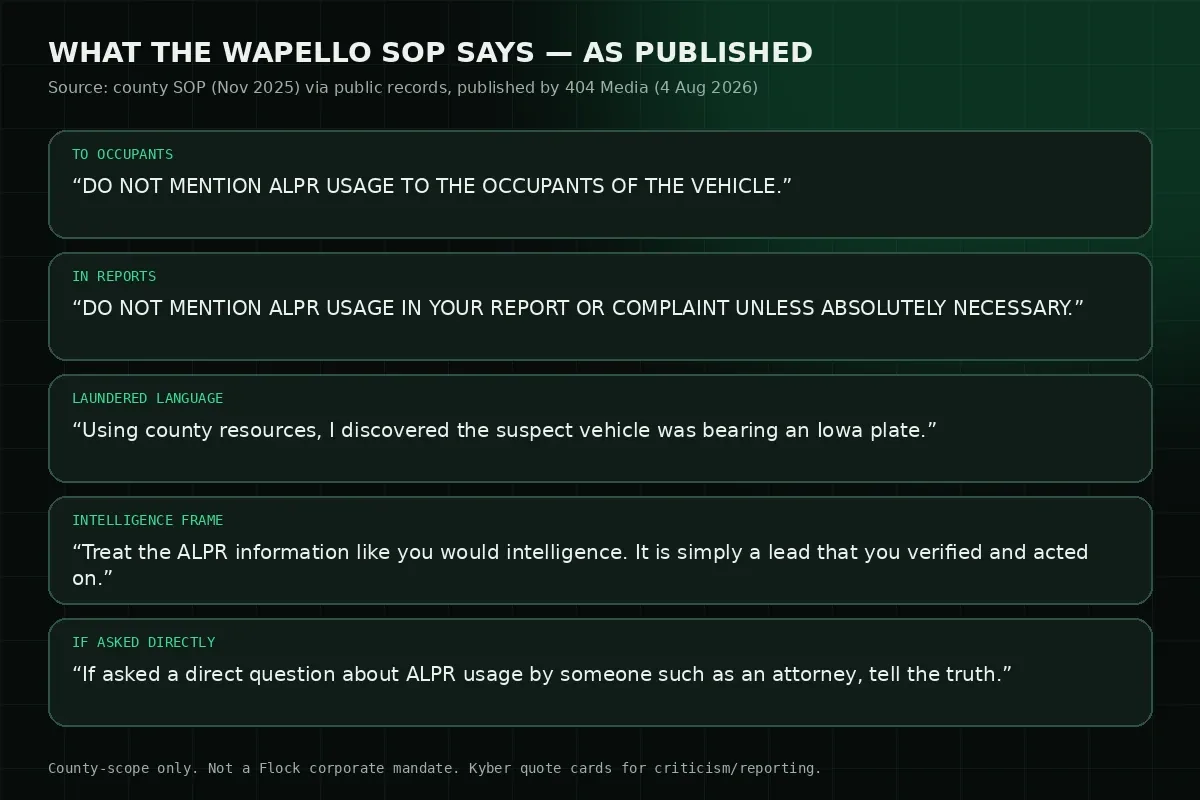
Quote card built from SOP language as published by 404 Media (August 4, 2026), PRA provenance. County-scope only. Not a scan of a raw PDF held by Kyber.
Compressed:
- Do not mention ALPR usage to vehicle occupants.
- Do not mention ALPR usage in the report or complaint “unless absolutely necessary.”
- If you must explain, prefer: “Using county resources, I discovered…”
- Treat ALPR information “like you would intelligence.”
- If an attorney asks a direct question about ALPR usage, tell the truth.
That last line is the tell. The default is concealment from the public-facing record. Candor is the exception carved out for lawyers who already know what to ask.
404 places the SOP next to Flock’s transparency and accountability marketing and notes prior reporting that multi-state guidance—and FBI/DOJ channels—urged officers to be “as vague as permissible” because searches can be FOIAed. That prior channel claim is 404’s earlier reporting, not a document Kyber re-proves in this package. The load-bearing primary here is the county SOP language itself.
Vendor and agency position
Sheriff Don Phillips, on the record in the 404 piece, said “there is no need” to tell people about the camera system. Deputies are required to check the plate and verify warrant, stolen vehicle, stolen plate, or missing person information. Methods and sources stay protected, he said, so criminals do not learn how to circumvent them. 404 also notes he did not respond to a separate request for comment after those statements.
That is a coherent police-methods argument. It is also the opposite of democratic product marketing. A system sold to councils as accountable infrastructure cannot, at the customer layer, train deputies to scrub the method from the story residents and reporters can later reconstruct.
Flock’s own site, captured for this brief, still pushes the other story: “Every search is logged and reviewable,” “Accountability is built into the system,” local agencies control access and sharing, compliance tools surface atypical activity. Those are real product features. They are also easy to oversell. A log the subject never hears about, buried under “county resources” report language, is not public transparency. It is internal telemetry.
Layer two — Roseville’s sample says the plate is often wrong
While Iowa was teaching deputies not to name the camera, California specialty coverage was doing the unglamorous thing: reading an accuracy problem.
CNET reported on August 4 that Roseville police, following complaints about incorrect vehicle flags, analyzed nearly 1,500 Flock reports and found a ~71% failure rate where cameras mistook one plate number for another. The analysis window is 2023–2024. CNET describes a concrete harm pattern: a citizen repeatedly flagged as driving a stolen car because the system read a 9 as an 8.
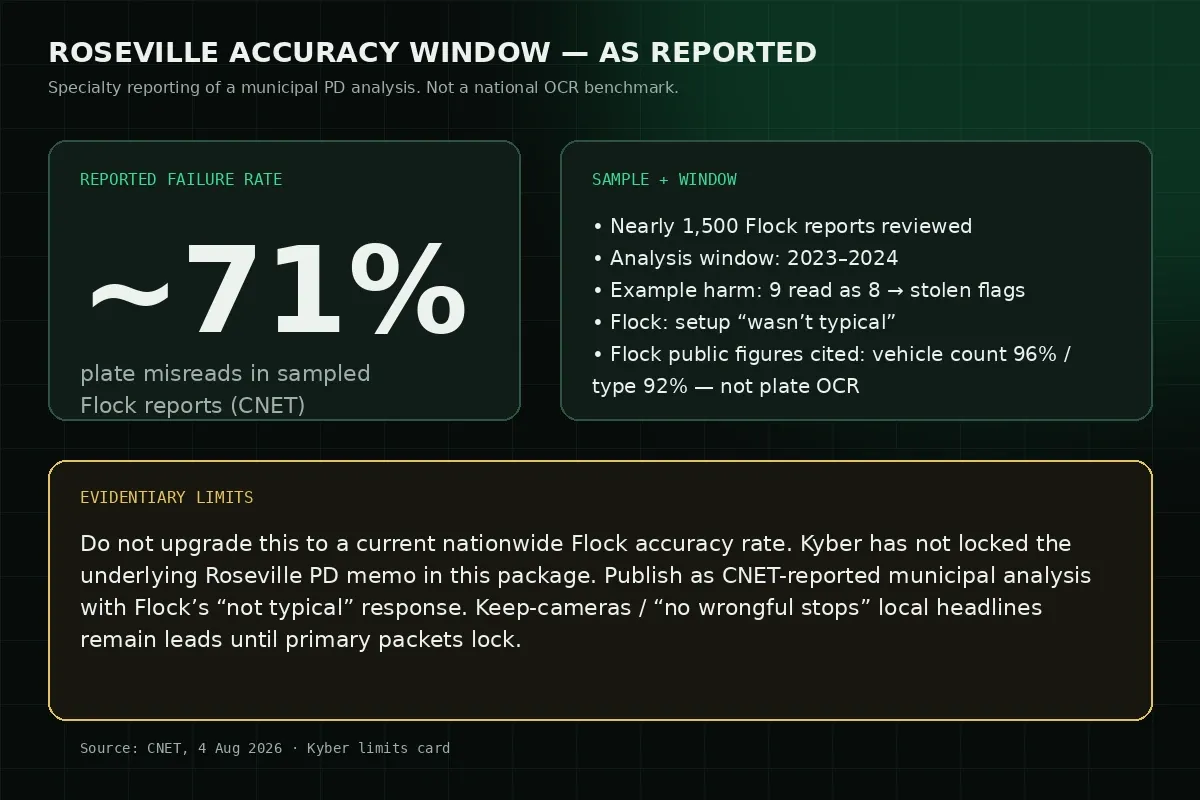
Limits card. Figures and window as reported by CNET, August 4, 2026. Not a national OCR benchmark and not a substitute for the underlying PD memo.
Two distinctions matter, and CNET actually draws them:
- Flock’s marketed accuracy numbers, as reported, lean on independent evaluations of vehicle count (~96%) and vehicle type (~92%). That is not the same metric as plate OCR.
- Flock’s response, as reported: the Roseville camera setup “wasn’t typical,” without much detail. Placement, night, weather, dirty plates, and covers can all degrade reads. True—and also a confession that everyday municipal conditions are part of the product’s operating environment.
Do not turn 71% into a mystical nationwide constant. Do turn it into a procurement question: if your city’s own sample says most alerts misread the plate, what is the false-attention budget you are buying, and who eats the cost when a wrong digit becomes a stop?
Local outlets are already circling keep-cameras and “no wrongful stops” angles. Until Kyber locks those bodies and the PD memo, treat them as a headline cluster, not as settled secondary facts in this brief.
Who benefits
| Actor | Incentive |
|---|---|
| Vendor | Land cities on a network graph; sell trust language (logs, local control, retention defaults) that survives council nights; keep OCR debates in the footnotes while count/type scores stay on the slide deck. |
| Agency command | Solve crimes and recover cars and protect methods from defense counsel, FOIA, and political blowback. Secrecy SOPs are a methods-protection tool. |
| Local electeds | Want a ribbon-cutting public-safety win without owning false stops, ICE-sharing fights, or “why didn’t you tell us” hearings. |
| Age-of-AI compliance vendors adjacent | Every accuracy scandal is also a services opportunity: audits, dashboards, “responsible ALPR” packaging. |
| Residents / drivers | Pay for the network in tax and attention risk; rarely see the hit log; learn about the method only if someone files records requests or an attorney asks the right question. |
Architecture, not anecdote
Kyber has been tracking this stack all summer: contracts and signing limits (Anoka), multi-product city packages (Huntington), cancel votes that are not deletion certificates (municipal ALPR exit), and the broader camera-network fight (Flock investigation).
This week’s addition is sharper:
- Secrecy is not a bug in one deputy’s instincts. It can be written policy.
- Accuracy is not a vibe. A city PD can generate a failure-rate sample that wrecks the sales deck—and still leave cameras up while the public argues about something else.
The network does not need every officer to be a villain. It needs quiet defaults: hide the method, keep the feed, dispute the sample as atypical, point at the audit log nobody outside the agency will ever page through.
Practical exits — lawful only
No sabotage. No plate bags as tradecraft cosplay. No instructions to disable anyone else’s equipment. If you want out of the panopticon as a resident or a small operator, use boring civic power and records.
1. Demand the documents, not the slogan
File or support public-records requests for:
- ALPR / Flock SOPs on disclosure to subjects, report writing, and defense counsel;
- the contract, order form, sharing defaults, and retention schedule;
- any accuracy tests, OCR audits, or vendor SLAs;
- hit/search audit logs policies (who can pull them, retention of the logs themselves, redaction rules);
- federal / out-of-network sharing ACLs and approval workflows;
- after any cancel vote: deprovisioning, historical data fate, and partner-access cutover—see Kyber’s exit brief.
2. Put three questions on the council record
- Notification: Are officers barred from telling drivers an ALPR hit started the stop? Where is that written?
- Accuracy: What is this city’s plate-read error rate on a recent sample, measured by the PD—not the vendor brochure—and what happens to a driver after a misread?
- Graph: Who outside this city can query our plate history today, under what approval, and what survives a contract end?
3. Separate “logged” from “accountable”
If the vendor says every search is logged, ask:
- Can a resident, journalist, or defendant obtain relevant log extracts through lawful process?
- How long are audit logs kept versus source images?
- Who reviews atypical queries, how often, and where are the public summaries?
A log that only the agency can see is a management feature. It is not community consent.
4. Personal exposure reduction without LARPing
- Drive a maintained, legal vehicle; fix plate lamps and mounts so you are not inventing OCR chaos for yourself or others.
- If you operate a small business with lot cameras or HOA security pitches, read the sharing defaults before you join a “safe city” network. Local control is a setting, not a personality trait.
- Own your domain, email, and audience so platform and payment drama stays separate from municipal surveillance fights. Different layer, same sovereignty habit.
5. Watchlist row (start here)
| Place | Peg | Status class | Next proof |
|---|---|---|---|
| Wapello County, IA | Secrecy SOP (Nov 2025) via PRA / 404 | Customer policy concealment | Raw SOP PDF + contract + sample redacted hit log policy |
| Roseville, CA | ~71% misread sample (2023–24) via CNET | Accuracy keep / contested | PD memo, methodology, current camera status packet |
What Kyber is not saying
Targeted investigation of stolen cars, abducted people, and serious crime is legitimate. Hiding the investigative surface from the democratic record is a different choice. Selling “accountability built in” while customers train “do not mention ALPR” is a third.
CSAM, trafficking, and violent crime do not justify a national plate graph with secrecy norms and unfixed OCR. They justify warrants, evidence, and accountable process—the boring stuff that does not need a sales engineer.
Bottom line
Flock’s moat is not a smarter camera. It is municipal capture + a queryable network + narrative control.
This week’s receipts show the customer layer will hide the hit and the model layer can misread the plate. Until councils force the SOPs, the accuracy samples, and the sharing graphs into the open, “trust and transparency” is just the homepage.
Agenda is not law on the Senate side either—five bills are still one permission-layer fight—but the ALPR machine does not wait for markup. It waits for the next quiet contract and the next report that says “county resources.”
Sources
- https://www.404media.co/do-not-mention-alpr-usage-how-cops-are-trying-to-hide-the-existence-of-flock/
- https://www.cnet.com/news/privacy/flocks-ai-cameras-may-have-misread-over-70-of-license-plates/
- https://www.flocksafety.com/
- https://www.flocksafety.com/trust
- https://www.flocksafety.com/privacy-ethics
- https://www.flocksafety.com/trust/data-privacy
- https://www.flocksafety.com/trust/compliance-tools
- https://kyberintel.com/blog/de-flock-is-the-easy-part-deprovisioning-is-the-story/
- https://kyberintel.com/blog/the-cameras-are-watching-now-people-are-cutting-them-down/
- https://kyberintel.com/blog/anokas-sheriff-priced-a-flock-drone-pilot-inside-his-signing-limit/
- https://kyberintel.com/blog/huntington-authorized-a-2-1-million-surveillance-stack-the-data-door-stays-behind-flocks-interface/