Five Bills, One Permission Layer
Wednesday’s Senate Commerce markup stacks SCREEN, KOSA, Youth AI Privacy, CHATBOT, and AI toy safety. Child-safety branding is the costume. The product is age resolution, platform design duties, and logged AI intimacy—and none of it is law yet.
Wednesday morning is not a narrow hearing about porn filters.
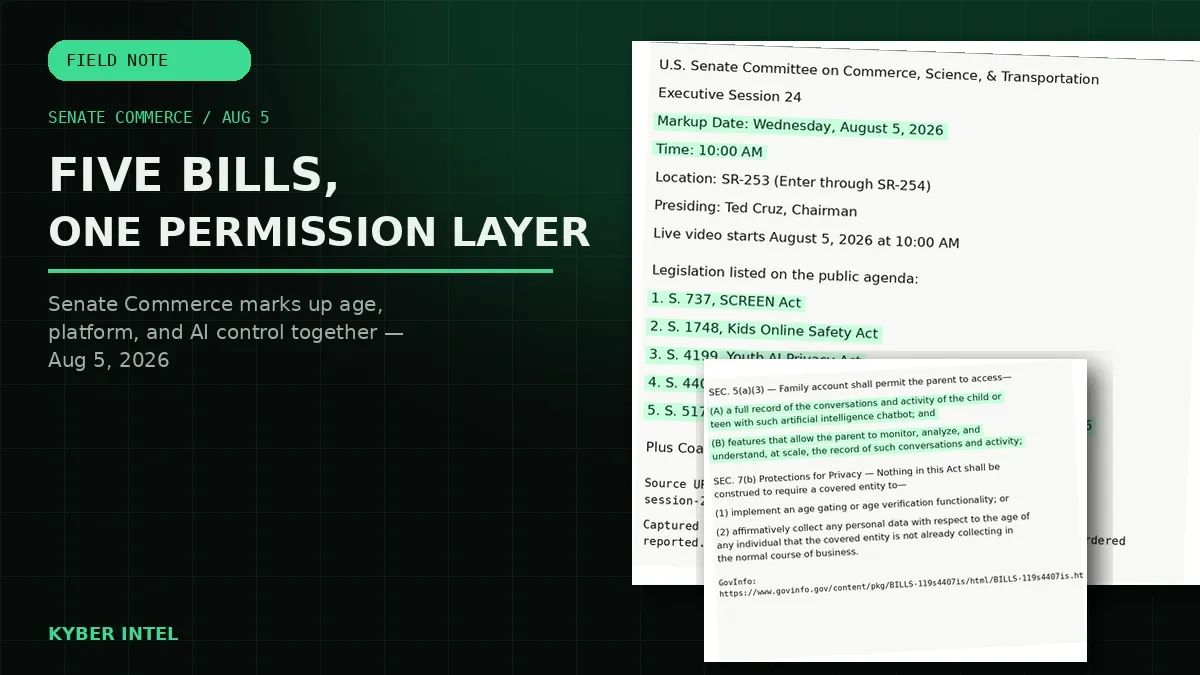
The Senate Committee on Commerce, Science, and Transportation has posted Executive Session 24 for Wednesday, August 5, 2026, at 10:00 a.m. in SR-253, with live video advertised. On the public agenda, under Chairman Ted Cruz, sit five bills in one room:
- S. 737 — SCREEN Act
- S. 1748 — Kids Online Safety Act (KOSA)
- S. 4199 — Youth AI Privacy Act
- S. 4407 — CHATBOT Act
- S. 5171 — Children’s Artificial Intelligence Toy Safety Act of 2026
Plus Coast Guard nominations. The nominations are not the story. The stack is.
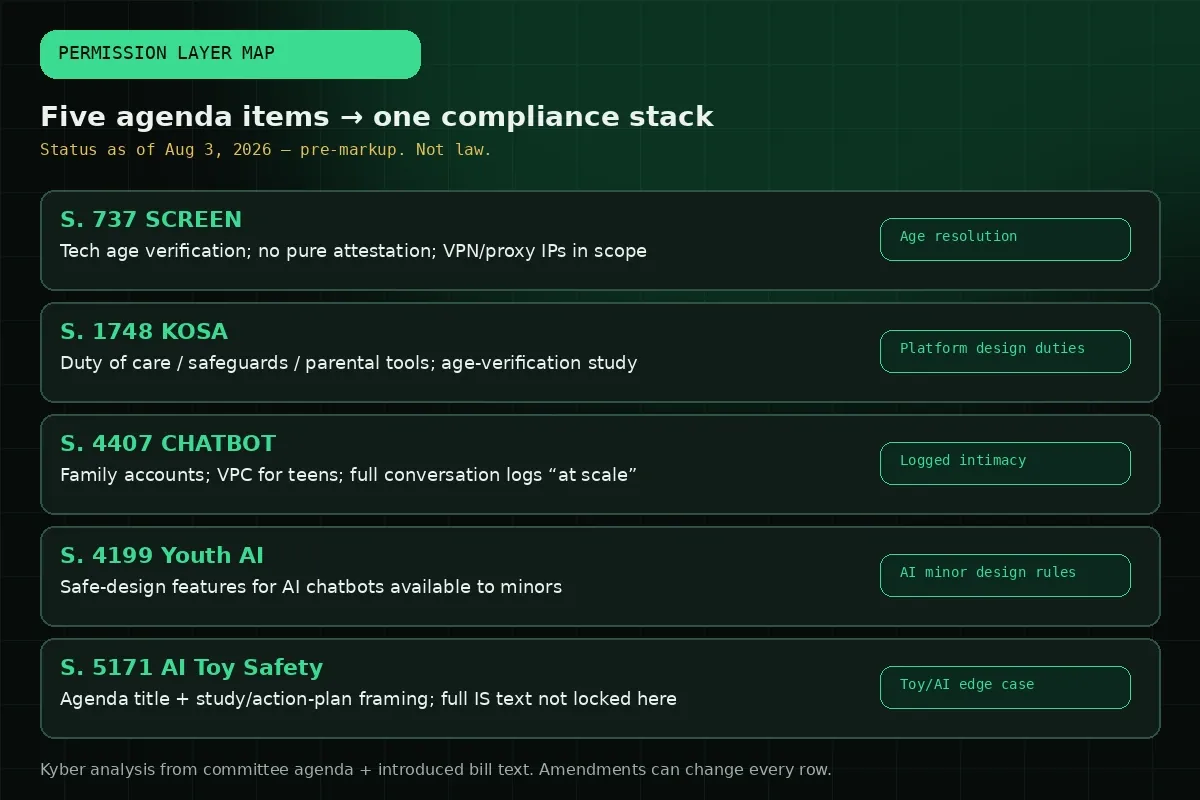
Kyber analysis map from the committee agenda and introduced bill text as of August 3, 2026. Not an official committee exhibit. Nothing on this map is law yet.
The thesis, tight
Child-protection language is the packaging. The product on the table is a permission layer:
- resolve the user’s age or minor status with technology, not a checkbox;
- impose design and duty-of-care rules on platforms that “know” they serve minors;
- for AI chatbots, install family accounts whose load-bearing feature is a full conversation record parents can monitor and analyze at scale.
That is one architecture story. Treating it as five separate “think of the children” newslets is how the compliance industry wins the week while readers argue about whichever bill has the catchier acronym.
Evidence boundary
Publication-ready now: the official agenda composition and timing; introduced-text substance of S. 737, S. 1748, S. 4407, and S. 4199 from GovInfo; GovTrack’s title/status framing for S. 5171; EFF’s July 31, 2026 advocacy pieces as counterparty advocacy, not statute.
Not established / do not upgrade:
- Any bill ordered reported, amended, or passed. Agenda ≠ law.
- Operative clauses of S. 5171 — the expected GovInfo introduced-text HTML returned page-not-found in this package; cite agenda title only (GovTrack describes a study/action-plan framing for AI-enabled toys).
- That CHATBOT creates a government chat backdoor. It creates a corporate family-log product that becomes a subpoena and civil-discovery magnet.
- That KOSA alone creates a national digital-ID wallet. It does build platform duties and orders a device/OS-level age-verification study.
- Final VPN-list provenance, manager’s amendments, or House companions.
What the agenda page actually says
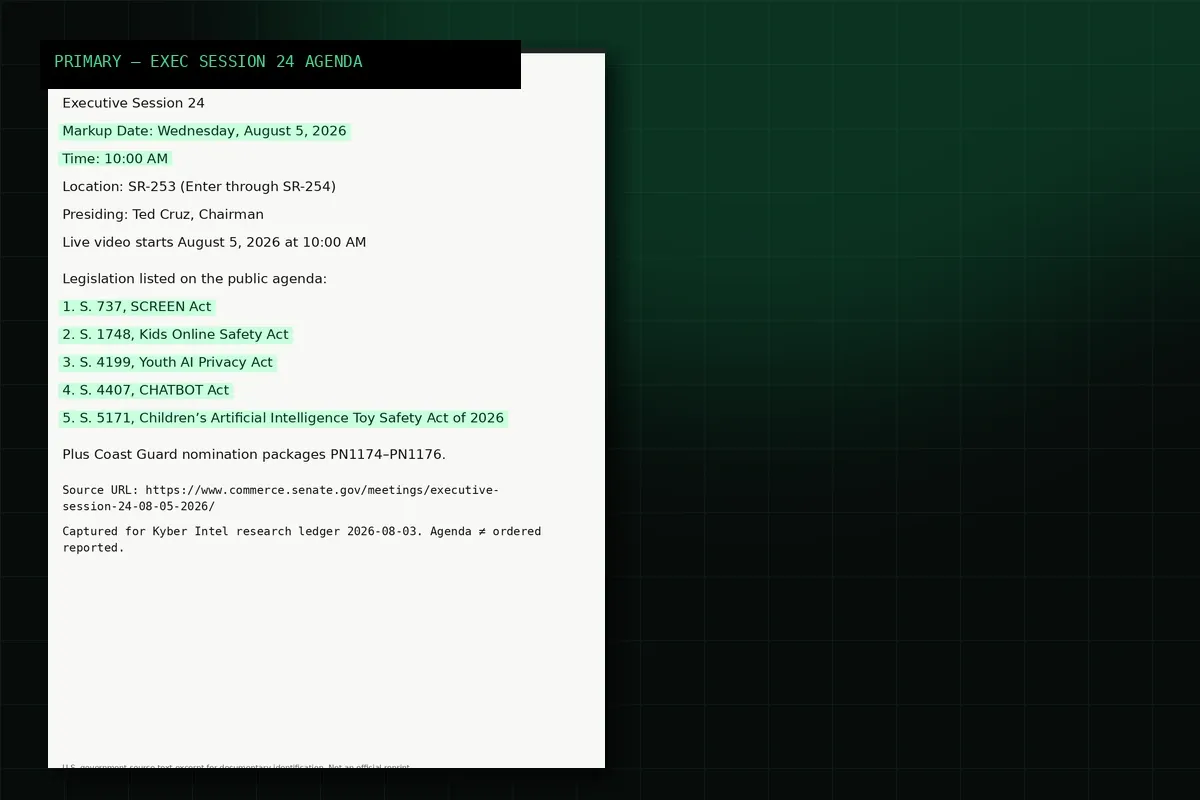
Source facts: U.S. Senate Committee on Commerce, Science, & Transportation, Executive Session 24 public page. Kyber documentary layout from the captured page — not a browser chrome screenshot and not a claim the committee “passed” anything.
The committee page is blunt enough: markup date, time, room, presiding chair, legislation list, live video. GovTrack’s S. 737 history continues to list the same August 5, 10 a.m. Commerce consideration. That is the peg. Everything else in this Field Note is what the introduced texts would force if enacted as written — labeled as such.
Load-bearing design 1 — SCREEN’s anti-checkbox and VPN/IP dragnet
S. 737, the Shielding Children’s Retinas from Egregious Exposure on the Net Act, is not subtle. Introduced February 26, 2025 by Senators Lee, Curtis, and Banks, the short title is the culture-war branding. Section 4 is the machine.
Beginning one year after enactment, a covered platform must adopt technology verification measures so users are not minors and minors cannot reach content “harmful to minors.” Then §4(b) does the real work:
- §4(b)(2): requiring a user to confirm they are not a minor is not sufficient.
- §4(b)(4): subject IP addresses, including known virtual proxy network IP addresses, of all users to the verification measure unless the platform determines, based on available technology, that the user is not located in the United States.
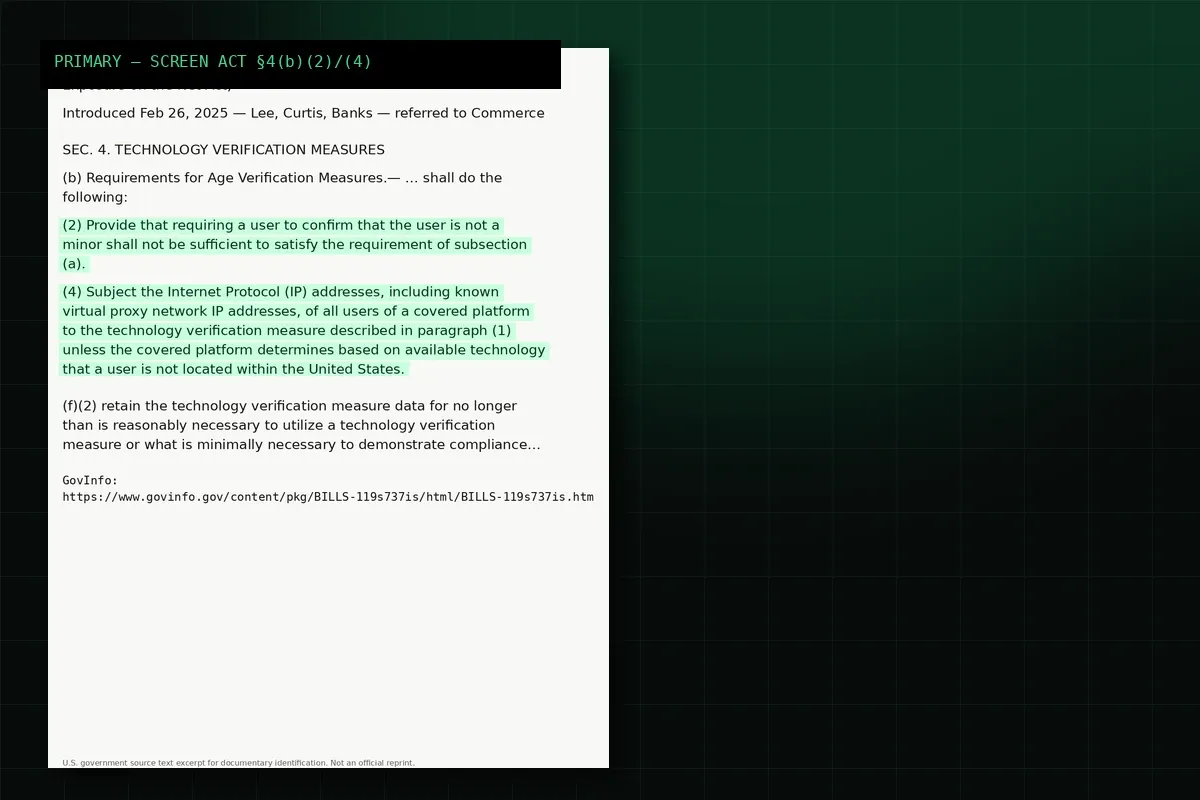
Source: S. 737 IS, GovInfo HTML. U.S. government work. Kyber layout for readability; full text in Sources.
Retention language is the usual soft landing: technology verification measure data kept no longer than is reasonably necessary to run verification or demonstrate compliance. “Reasonable” is not a hard delete clock. Third-party verifiers are allowed; liability stays with the platform.
EFF’s India McKinney wrote on July 31, 2026 that SCREEN threatens privacy far beyond adult websites. That is advocacy analysis. The bill text is the receipt. Kyber’s line is simpler: if your “child safety” design has to bag known VPN IPs to function, you are not building a porn filter. You are building a who-are-you / where-are-you checkpoint and daring adults to prove they are allowed online.
Load-bearing design 2 — CHATBOT’s full-record family account
S. 4407, the CHATBOT Act, introduced April 28, 2026 by Senators Cruz, Schatz, Curtis, and Schiff, targets public-facing services whose primary function is an open-ended AI chatbot — not every scripted help desk. Definitions matter. So does the product mandate.
-
Known children (under 13): family account required.
-
Known teens (13–17): direct parental notice + verifiable parental consent (COPPA definition) before account creation; family account offered; defaults locked protective if no family account.
-
§5(a)(3): any qualifying family account shall permit the parent to access:
- (A) a full record of the conversations and activity of the child or teen with the chatbot; and
- (B) features that allow the parent to monitor, analyze, and understand, at scale, that record.
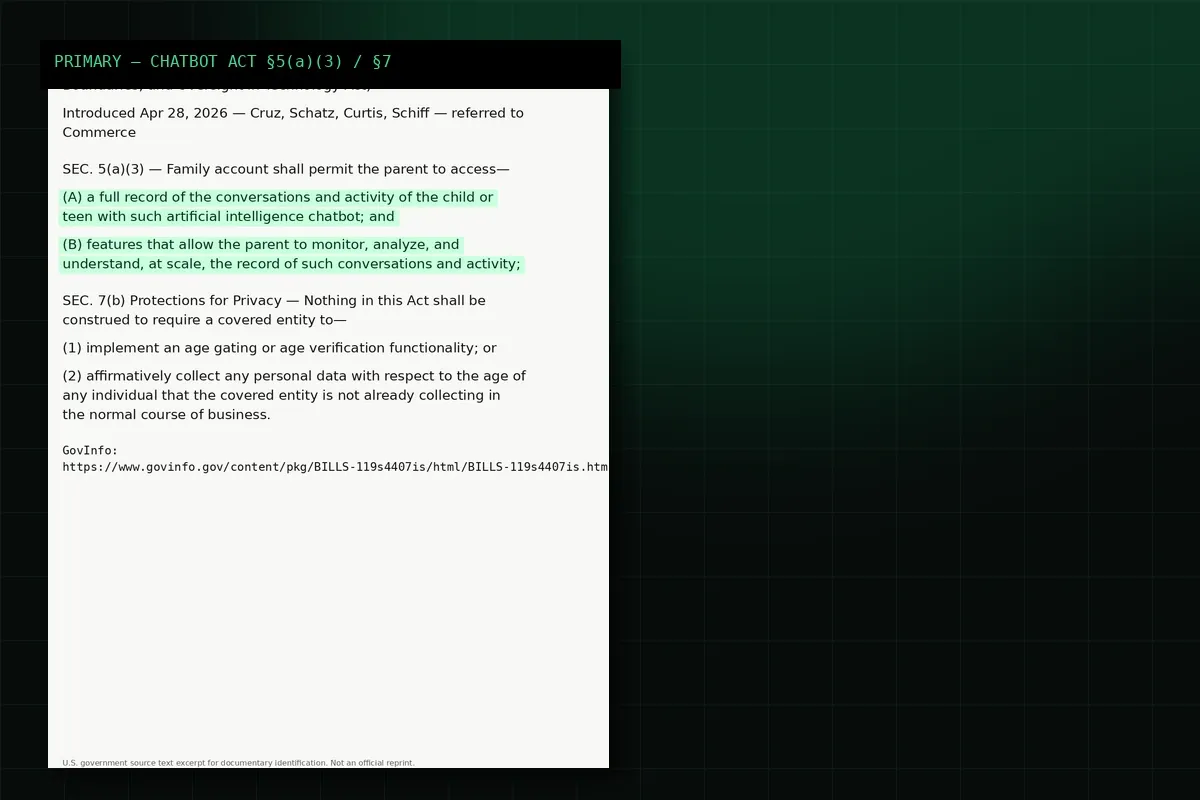
Source: S. 4407 IS, GovInfo HTML. U.S. government work. Kyber layout; full text in Sources.
Then comes the talking-point section. §7(b) says nothing in the Act shall be construed to require age gating/age verification or new age-data collection outside the normal course of business. Read it next to VPC, knowledge standards (“actual knowledge or knowledge fairly implied”), family-account defaults, and a compliance industry that already sells age assurance. The statute performs privacy theater with one hand and ships a conversation-logging schema with the other.
EFF’s Joe Mullin (July 31, 2026): the Act forces one parenting model on every family. Kyber’s sharper cut: parents who own devices already have supervision tools. A federal mandate that AI companies retain and surface full minor chat histories industrializes family surveillance and trains the next cohort that intimate machine conversation is never private — a norm schools, app stores, and foreign regulators will copy even if the “parent” is the marketing face.
This is not the same claim as “the government reads your kid’s chatbot.” It is the claim that logged intimacy becomes infrastructure, and infrastructure gets subpoenaed.
The rest of the package without overclaiming
KOSA (S. 1748) is the durable platform bill: duty of care, safeguards for minors, disclosures, transparency, and — quietly important — §107, a Commerce/FCC/FTC study of the most technologically feasible methods for device- or operating-system-level age verification. Even when a bill’s lawyers swear it does not “require” age gates, the study and compliance ecosystem points the industry at OS/store passports. That continues the stack Kyber mapped after the Fifth Circuit’s SCOPE posture: filters can lose; age-status infrastructure still scales.
Youth AI Privacy Act (S. 4199) is the Markey safe-design bill for AI chatbots available to minors: repeated “this is not a human” disclosures, FTC-ruled limits on how long minor personal data can steer outputs inside a session, bans on compulsive engagement patterns (rewards, unsolicited pings, fake typing bubbles), and limits on ads, profiling, and training on minor personal data. Useful pieces exist. The knowledge trigger still pressures identity resolution in production systems.
S. 5171 appears on the agenda as the Children’s Artificial Intelligence Toy Safety Act of 2026. GovTrack describes a study of AI-enabled toys and a joint action plan on marketing and sale, introduced July 29, 2026, scheduled for the same Commerce meeting. Kyber does not quote operative statutory clauses for 5171 in this package because the expected GovInfo introduced-text path 404’d at capture. Agenda presence is real. Clause-level claims wait for text.
Vendor and agency position
| Actor | Position (documented or clearly expected) |
|---|---|
| Sponsors / child-safety coalition | Existing filters failed; AI companions and compulsive design harm teens; parents and platforms need mandates. Bill findings and bipartisan face cards do that work. |
| EFF | SCREEN’s verification model hits privacy beyond adult sites; CHATBOT locks in a monitoring-first family model (July 31, 2026 deeplinks). |
| Platforms and AI labs | Will ship compliance dashboards either way; some will welcome a liability narrative that turns “we log everything for safety” into the responsible default. Primary lobby letters not attached in this pre-markup note. |
| FTC / state AGs | Named enforcers in CHATBOT and related constructions — power expands if text moves. |
Kyber does not defend CSAM, grooming, or predation. Targeted investigation with warrants and due process is not the same as universal age-resolution infrastructure plus default conversation panopticons. Cars are used in crimes. We still do not tattoo a license plate on every pedestrian — or force every adult VPN user through an identity bouncer to read the news.
What to do before Wednesday — lawful exits only
- Watch the markup, not the spin. Live video is advertised for 10:00 a.m. ET on August 5. Track what is ordered reported, what is amended, and whether the SCREEN VPN/IP clause or CHATBOT full-record clause moves. Kyber will upgrade this Field Note into a Threat Brief when outcomes exist.
- Contact Commerce members with specifics, not vibes. Cite §4(b)(2)/(4) and §5(a)(3). Demand crime-fighting tools that require evidence — not population-scale identity APIs.
- Assume store-level age signals expand regardless of one bill’s floor fate. Play Age Signals and state regimes already moved; see Kyber’s Fifth Circuit / age-gate stack brief.
- For sensitive AI use, prefer local/open-weight models you run. Do not put a minor’s crisis counseling solely inside a cloud companion that will be forced to log “at scale.”
- Own identity infrastructure: domain, email, exportable audiences, hardware keys. Permission layers love rented accounts.
- If you are in California, the broker deletion bus is already live — DROP is a bus, not a broom. It will not stop a federal age API. It still shrinks the dossier market that feeds everyone else.
What happens after the gavel
If Commerce marks these up as a package, the story is not “five kids bills advanced.” The story is whether the United States is standardizing a who-are-you layer for the open web and a who-read-the-chat layer for AI. Post-markup Kyber work: same map, updated status rows, amendment diffs, and a stack line next to Play Age Signals, Discord’s Texas temporary-injunction clock, and New York Part 700.
Until then, the honest headline is procedural and architectural at once:
Five bills. One permission layer. Not law — yet. Watch the text, not the costume.
Sources
- https://www.commerce.senate.gov/meetings/executive-session-24-08-05-2026/
- https://www.govinfo.gov/content/pkg/BILLS-119s737is/html/BILLS-119s737is.htm
- https://www.govinfo.gov/content/pkg/BILLS-119s1748is/html/BILLS-119s1748is.htm
- https://www.govinfo.gov/content/pkg/BILLS-119s4407is/html/BILLS-119s4407is.htm
- https://www.govinfo.gov/content/pkg/BILLS-119s4199is/html/BILLS-119s4199is.htm
- https://www.govtrack.us/congress/bills/119/s5171
- https://www.govtrack.us/congress/bills/119/s737
- https://www.eff.org/deeplinks/2026/07/screen-act-threatens-privacy-far-beyond-adult-websites
- https://www.eff.org/deeplinks/2026/07/chatbot-act-forces-one-parenting-model-every-family
- https://kyberintel.com/blog/texas-didnt-lose-age-gates-it-lost-the-filter-mandate/
- https://kyberintel.com/blog/drop-is-a-bus-not-a-broom/