Trusted Traveler Became a Retaliation Layer in the Observer Cases
Primary complaints allege field face and plate capture joined traveler systems that can strip Global Entry. Allegations, architecture, and lawful exits—not a verdict.
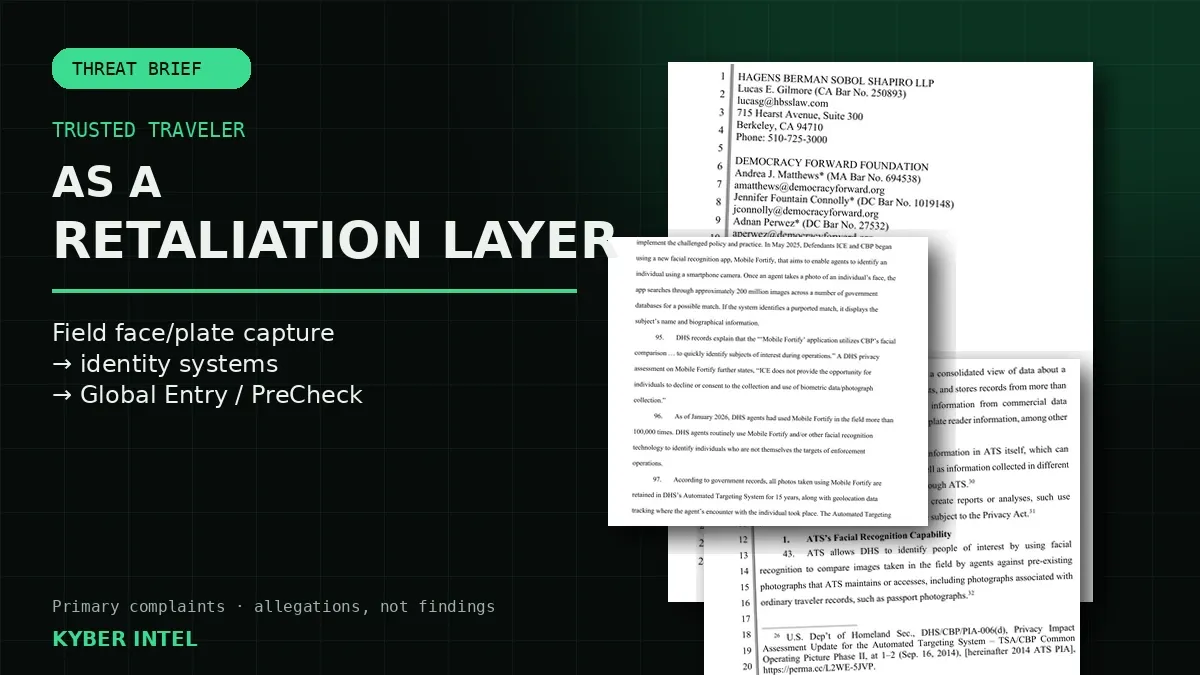
The dangerous part of the new observer lawsuits is not only a phone pointed at a face in a parking lot.
It is the handoff.
A 24 July 2026 federal complaint in the Southern District of California alleges that people who watched or recorded immigration enforcement lost Global Entry and TSA PreCheck soon afterward. An earlier Maine class complaint describes street-level face and plate capture, “domestic terrorist” threats, and a facial-recognition app that plaintiffs say writes into traveler-screening systems. A Minnesota complaint describes plate-based home-follow intimidation against observers.
None of that is a court finding. Civil complaints are accusations. Agencies deny speech-based Trusted Traveler retaliation. The architecture question still stands either way:
If field biometrics and plate captures can become inputs to systems that gate movement privileges, observation of government agents becomes a portable penalty long after the encounter ends.
That is control technology with a customer-service face. Global Entry feels like a perk until it becomes a switch.
What the 24 July complaint alleges
On 24 July 2026, the Electronic Privacy Information Center and three U.S. citizens—Nicole Cleland, Jacquelyn Ivey, and Anna Walker—filed a complaint in the U.S. District Court for the Southern District of California, Case No. 3:26-cv-04232-AJB-MSB, against DHS, ICE, CBP, and named officials in their official capacities. Democracy Forward counsel appear on the caption. Kyber retrieved the hosted complaint PDF directly.
The complaint’s core narrative, on its face:
- Cleland (Minnesota): On 10 January 2026 she says she followed suspected federal vehicles at a safe distance. A Border Patrol agent allegedly approached, addressed her by name, claimed “facial recognition,” said a body camera was running, accused her of impeding work, and threatened arrest. Three days later she received email notice that her Global Entry/TSA PreCheck had been revoked without a stated reason. She says she had no other intervening law-enforcement contact and stopped observing out of fear of arrest.
- Ivey (South Carolina → Charlotte): In November 2025, agents allegedly surrounded her car, photographed her face and plate, detained her for identification, and only then let her leave. Ten days later her Global Entry was revoked. After press coverage, CBP’s Ombudsman allegedly overturned the revocation in March 2026. She says she received no confirmation that underlying records were deleted.
- Walker (San Diego): On 1 April, in a public Target lot, agents allegedly boxed in her car, aimed phones at her face and plate, and held her for about twenty minutes until she called 911. Five days later her Global Entry showed revoked. After a reporter inquired with her name and date of birth, the status was allegedly reinstated the next day—again without assurance that source records were erased.
The complaint’s theory is not that DHS maintains a system labeled “protester database.” It is that any retrievable face, plate, or identity record created because someone watched government agents can still function as a dossier—and that Trusted Traveler continuous vetting is one place those records can bite.
It further alleges that ATS (Automated Targeting System) is CBP’s primary Trusted Traveler vetting tool, that ATS can perform facial-recognition queries against field images and traveler holdings, and that CBP may suspend or revoke trusted status when “new records available through ATS” warrant a change, including a broad residual category of “any other legitimate reason.”
Those are plaintiff characterizations of DHS policy documents cited in the complaint. Kyber has the complaint. Kyber does not independently republish the underlying PIA/SORN PDFs in this package.
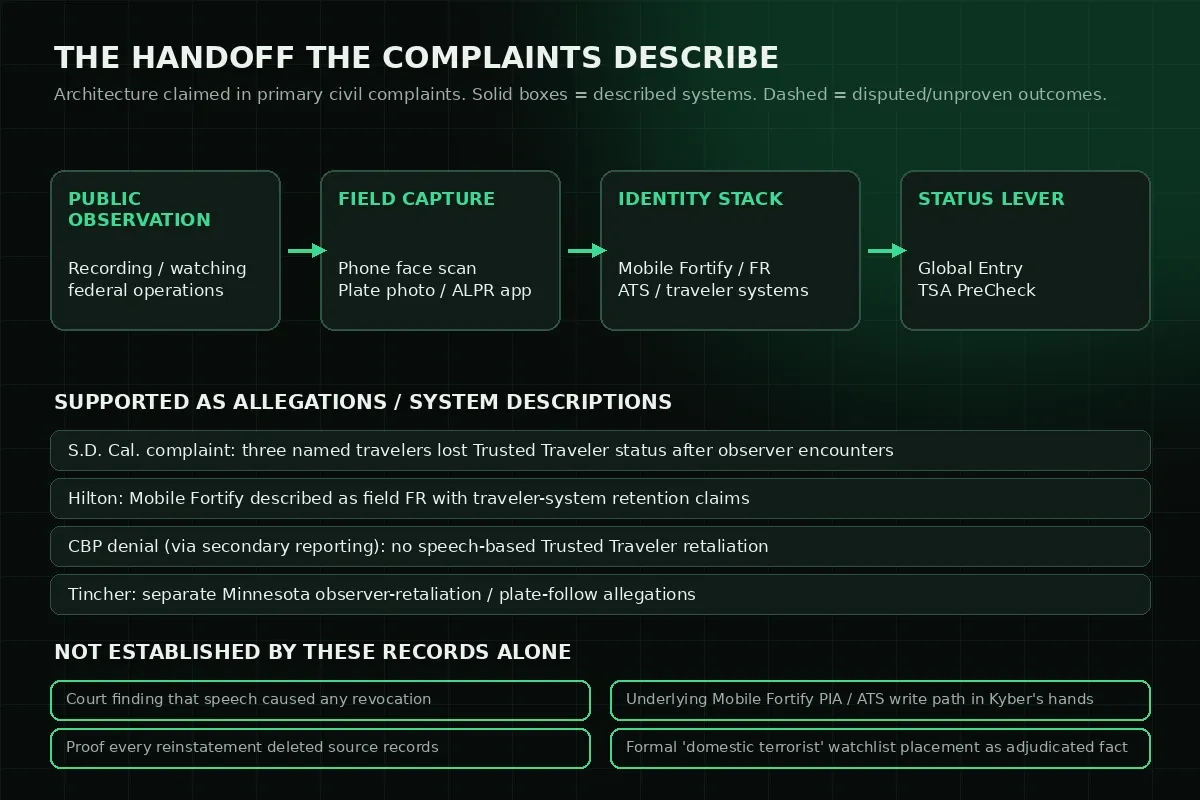
Kyber reconstruction from the face of the primary complaints and the attributed CBP response. Solid boxes describe systems and allegations in the filings. Dashed items remain unproven as adjudicated fact.
Maine and Minnesota fill in the street layer
The California filing is the clean Trusted Traveler peg. It is not the only primary record.
Hilton v. Noem (D. Maine, filed 23 Feb 2026)
Elinor Hilton and Colleen Fagan v. Kristi Noem et al., No. 2:26-cv-00092-JAW, is a class-action complaint on RECAP. Plaintiffs allege Maine observers had faces and plates captured while documenting immigration operations, were told they were “domestic terrorists,” and were threatened with databases and home visits.
On the face of the complaint:
- An agent allegedly told Fagan, after capturing her plate, “Cause we have a nice little database. And now you’re considered a domestic terrorist, so have fun with that.”
- At a South Portland Home Depot on 21 January 2026, agents allegedly filmed Hilton’s face and car; one allegedly said if she kept coming she would go on a “domestic terrorist watchlist” and agents would “come to your house later tonight,” with another agent affirming, “Oh, absolutely.”
- The complaint describes Mobile Fortify as a May 2025 ICE/CBP smartphone facial-recognition app searching a very large government image gallery, with no opportunity to decline collection, more than 100,000 field uses as of January 2026, and photo retention in traveler-related systems for 15 years—all as characterizations of government records cited by plaintiffs.
- It alleges a September 2025 ICE payment of $3.8 million for Clearview AI tools.
- It alleges one Minnesota observer lost Global Entry without explanation days after facial recognition identified her, and recounts an agent allegedly telling another observer that a vehicle’s registered owner would “have fun trying to travel.”
The same complaint notes DHS denials of a “domestic terrorist” database and argues the fork explicitly: either the records/threats are real, or agents are lying about watchlists to intimidate observers. Either fork is a speech problem. Neither fork is a verdict.
Tincher v. Mullin (D. Minnesota, filed 17 Dec 2025)
Susan Tincher et al. v. Kristi Noem et al., No. 0:25-cv-04669, is a separate Minnesota class complaint. On the face of the text Kyber extracted, it focuses on alleged retaliatory force, detention, intimidation, and plate-based “we know where to find you” / home-follow tactics against observers and protesters. It is primary evidence of the broader observer-retaliation pattern. It is not, by itself, a Global Entry case.
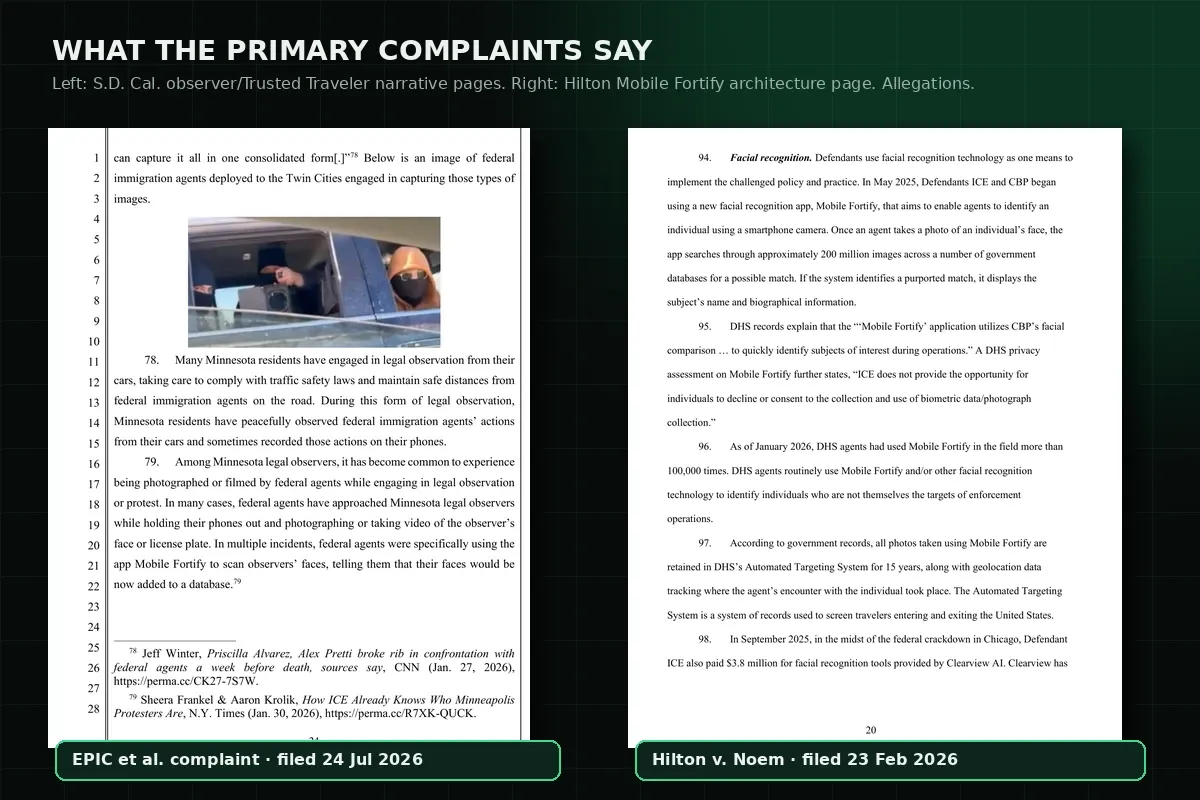
Source: public federal civil complaints retrieved 27 July 2026. Left panel from the EPIC et al. S.D. Cal. filing; right panel from Hilton v. Noem (D. Me.). These pages contain allegations and counsel argument, not findings of fact.
The vendor and agency position
Customs and Border Protection, as quoted in Anthony Kimery’s 27 July 2026 Biometric Update report on the California case, denies that Trusted Traveler memberships are revoked in retaliation for protected speech. The quoted position is the ordinary one: status may be withdrawn for criminal activity, outstanding warrants, customs or immigration violations, or inability to show the person remains a low-risk traveler.
That denial matters. Publish it next to the allegations.
What the denial does not do is make the architecture disappear. Continuous vetting means new derogatory inputs can reopen a privilege. If field observer captures can become those inputs—through ATS, case files, watchlists, broker data, or informal risk notes—then “we don’t retaliate for speech” becomes a labels fight while the pipeline stays live.
Hilton’s complaint also records official denials of a dedicated “domestic terrorist” observer database. Kyber treats those denials as part of the record, not as comic relief and not as proof that nothing was stored.
No court in the packages reviewed here has found that any named plaintiff’s Global Entry loss was caused by protected observation. Some revocations were allegedly later restored. Restoration is not a merits finding, and it is not proof of deletion.
Why the join matters more than the slogan
Surveillance debates get stuck on the camera. The higher-leverage layer is privilege infrastructure.
A still image on an agent’s phone is local. A face probe against a government gallery is identity resolution. A write into a traveler-screening system is durable. A Trusted Traveler revocation is a real-world sanction that does not require a criminal charge, a public hearing, or a press conference.
That stack converts a messy street encounter into a clean administrative outcome:
- observe government agents in public;
- get face/plate captured;
- become a record;
- lose a travel privilege—or fear losing one enough to stop watching.
Even if every current defendant eventually wins on the facts, the product design lesson remains. Convenience programs are policy levers. Airlines sold the dream of shorter lines. The state retained the kill switch.
This is the same family of problem as device attestation, payment deplatforming, and app-store lockouts: a benefit layer that looks optional until dependency makes it compulsory in practice.
What ordinary people can do now
No sabotage. No fake “anti-surveillance” gadgets. No instructions for evading lawful orders. The useful moves are boring and structural.
1. Stop treating Trusted Traveler as a right
If your work, family, or activism makes sudden status loss costly, build travel plans that survive ordinary screening. A convenience enrollment is not an entitlement and not a speech shield.
2. Separate high-risk observation from identity-linked travel where lawful and practical
People who document public authority already know the camera points both ways. Use devices and accounts you control. Prefer local storage you can export. Do not store only copies inside platforms that can lock you out. This is operational hygiene, not a magic cloak.
3. Demand the record path, not the slogan
For any encounter that leads to a benefit denial, ask in writing:
- what system created the record;
- what identifiers were stored (face template, photo, plate, DL image, geolocation);
- retention by object type;
- sharing partners;
- the specific reason code for Trusted Traveler action;
- the deletion or correction path after reinstatement.
“Reinstated” without deletion is a suspended sentence.
4. Use public records and oversight channels
FOIA/Privacy Act requests, congressional casework, CBP Ombudsman processes, and civil counsel are the lawful routes. Local ALPR sharing with federal partners belongs in city contract fights—the same accountability trail Kyber has pushed on Flock procurement in Anoka and Huntington.
5. Reduce broker and plate exposure you actually control
Data-broker opt-outs, privacy-preserving vehicle choices where practical, and skepticism toward “safe traveler” apps that harvest more than they return still matter. California residents should keep DROP on the calendar as broker compliance pressure builds. Broker files are how a plate becomes a person without anyone admitting a watchlist exists.
6. Keep the legal categories honest
Anonymous observation and journalism are not the same thing as assault, doxxing, or blocking emergency operations. Kyber’s line stays fixed: target proven crimes with warrants and due process. Do not launder universal identity infrastructure through the existence of offenders.
For the larger pattern of mobility surveillance without a clean constitutional settlement, see Kyber’s ALPR / geofence limits brief and the Flock backlash investigation. For the federal data-fusion side of ICE alerting, see the Thomson Reuters / DASS package.
Evidence boundary
Proven from the current record:
- EPIC, Cleland, Ivey, and Walker filed a 24 July 2026 S.D. Cal. complaint alleging observer encounters followed by Trusted Traveler revocations, with partial later reinstatements for Ivey and Walker as alleged.
- Hilton v. Noem (D. Me., 23 Feb 2026) alleges face/plate capture, “domestic terrorist” database/watchlist threats, Mobile Fortify architecture claims, Clearview procurement claims, and travel-privilege interference examples.
- Tincher v. Mullin (D. Minn., 17 Dec 2025) alleges observer retaliation and plate-based intimidation/home-follow tactics.
- Biometric Update reports CBP’s denial of speech-based Trusted Traveler retaliation and ordinary risk/violation grounds for removal.
Not proven by these records alone:
- that any court has found speech caused a Global Entry/PreCheck revocation;
- that any plaintiff was formally placed on a national terrorist watchlist;
- Mobile Fortify gallery composition, match thresholds, or ATS retention as independently verified by Kyber from the underlying DHS PIA/SORN files;
- that the alleged Clearview payment occurred on the terms stated, without the contract vehicle;
- that reinstatement deleted source records;
- denominators: how many observers, how many revocations, how many alternative explanations.
The honest headline is narrower than the rage headline:
Primary complaints now describe a pipeline from public observation to traveler-privilege loss. The government denies retaliatory motive. The join between street biometrics and administrative gates is the story that survives either outcome.
Sources
- https://democracyforward.org/wp-content/uploads/2026/07/2026-07-24-1-Complaint.pdf
- https://storage.courtlistener.com/recap/gov.uscourts.med.69985/gov.uscourts.med.69985.1.0.pdf
- https://storage.courtlistener.com/recap/gov.uscourts.mnd.229758/gov.uscourts.mnd.229758.1.0_5.pdf
- https://www.biometricupdate.com/202607/dhs-accused-of-tracking-immigration-observers-and-retaliating-through-global-entry