Robocall Relief That Ends Anonymous Phones
FCC FNPRM 26-27 seeks comment on forcing name, address, government ID number, and alternate phone for new and renewing customers. Robocall language is the costume. Identity-linked telephony is the product. Proposed, not final.
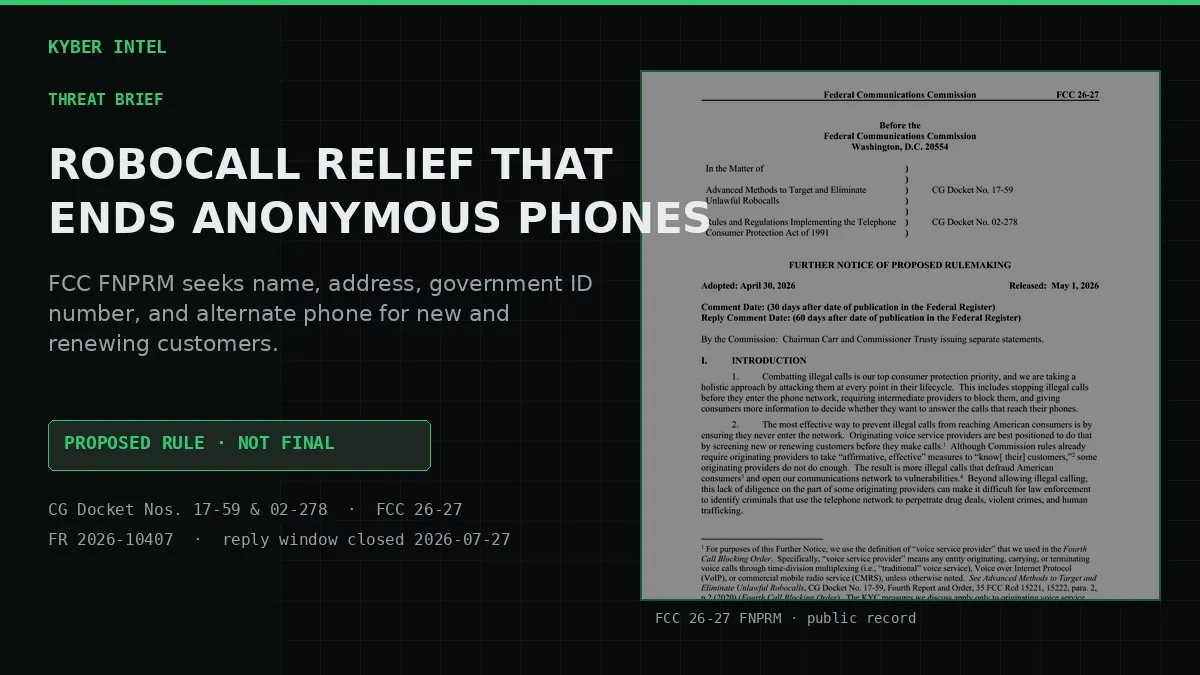
The pitch is robocalls. The payload is a phone that only works after you hand the carrier a government identity package.
That is not a blogger paraphrase. It is the Federal Communications Commission, in a Further Notice of Proposed Rulemaking, asking whether originating voice providers should have to collect — at a minimum — your name, physical address, government issued identification number, and an alternate telephone number before you get service.
Proposed. Not final. Still the architecture of a real-name telephony regime, laundered through consumer-protection language Americans already hate enough to rubber-stamp.
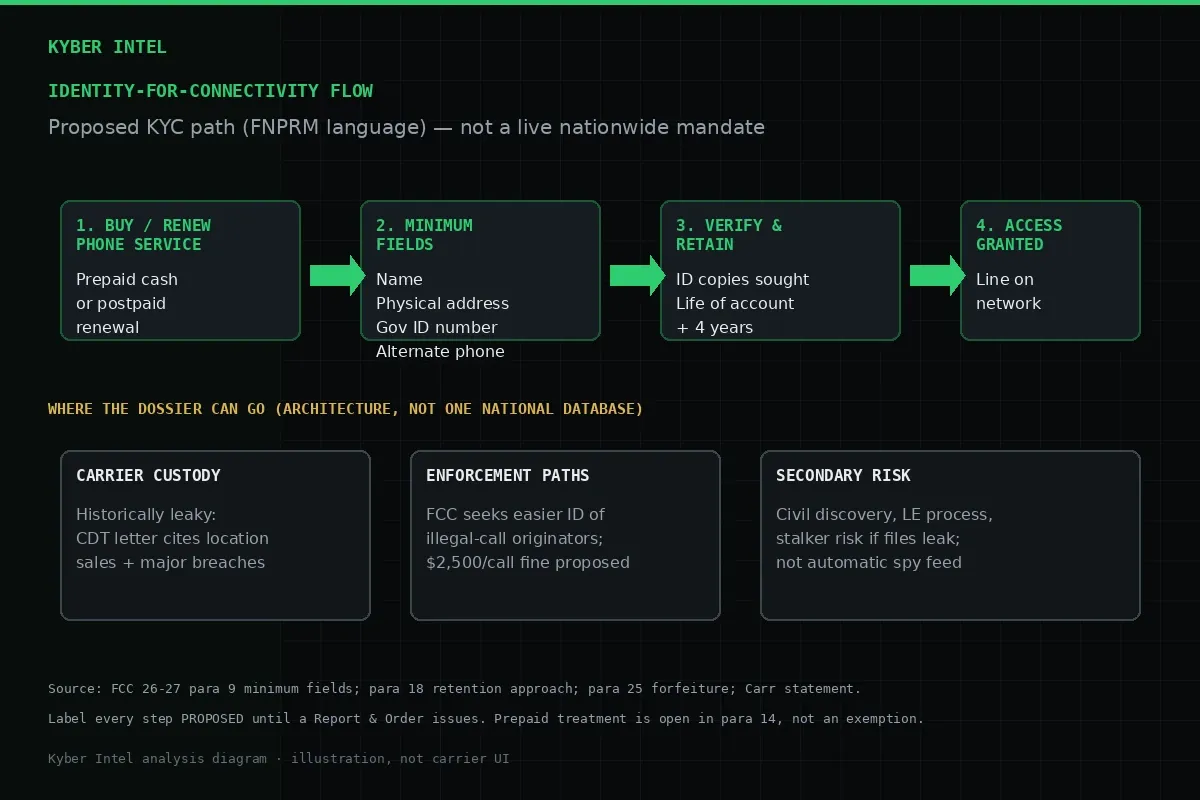
Kyber analysis diagram of the proposed KYC path in FCC 26-27. Illustration of proposal language — not a live nationwide mandate and not a carrier app screenshot.
Evidence boundary
Publication-ready:
- Full text of FCC 26-27, Advanced Methods to Target and Eliminate Unlawful Robocalls / TCPA FNPRM, CG Docket Nos. 17-59 and 02-278, adopted April 30, 2026, released May 1, 2026: docs.fcc.gov PDF.
- Federal Register proposed-rule summary FR Doc 2026-10407, published May 26, 2026, titled Enhancing Know-Your-Customer Requirements: Federal Register / GovInfo PDF. Comment date June 25, 2026; reply comments July 27, 2026.
- Exact minimum-field language in FCC 26-27 ¶9 (quoted below).
- Retention approach in ¶18 (KYC information and supporting records for four years following termination of the customer relationship — sought as the approach under comment).
- Verification language in ¶19 (supporting records such as copies of government-issued identification).
- Prepaid/postpaid questions in ¶14 (open design choice, not a prepaid exemption).
- Enforcement proposal in ¶25 ($2,500 base forfeiture per call for KYC rule violations — proposed).
- Chairman Brendan Carr and Commissioner Olivia Trusty statements attached to FCC 26-27 (agency framing).
- Center for Democracy & Technology et al. multi-organization letter, July 27, 2026, opposing mandatory subscriber identity-document collection: CDT PDF.
- Secondary continuity: 404 Media free lede, June 9, 2026 (ACLU quote in free text); Techdirt May 19 and August 7, 2026.
Not established / do not upgrade:
- That the FCC has adopted a final rule ending cash prepaid or “burner” phones nationwide. It has not, in this package.
- That every prepaid SIM is already illegal without ID today under this FNPRM.
- That KYC files automatically become a real-time federal dashboard. Custody starts with originating providers; secondary access still runs through legal process, breaches, brokers, and civil discovery — bad enough without inventing a single national switchboard.
- That the proposal will stop overseas-origin illegal robocalls. The CDT letter argues the opposite direction of travel; the FNPRM asserts deterrence and easier enforcement. Efficacy is contested, not proven here.
- Complete carrier-association reply comments or the full ECFS comment census (not locked in this package).
- Sidebar items as the main holding: tower-dump constitutionality nationwide; foreign SIM-registration regimes as U.S. law.
The thesis, tight
- Robocall enforcement is the public face.
- Identity-linked origination is the control product.
- If finalized as the minimum fields read, lawful anonymous phone access in the U.S. becomes a historical artifact — not because scams ended, but because identity collection scaled.
This sits next to the rest of the permission stack Kyber already tracks: age-gate and chatbot logging bills, device attestation as a permission slip, and carrier lock-in on the hardware you thought you bought. Different statutes. Same direction of travel: you may connect after you identify.
What the FNPRM actually says
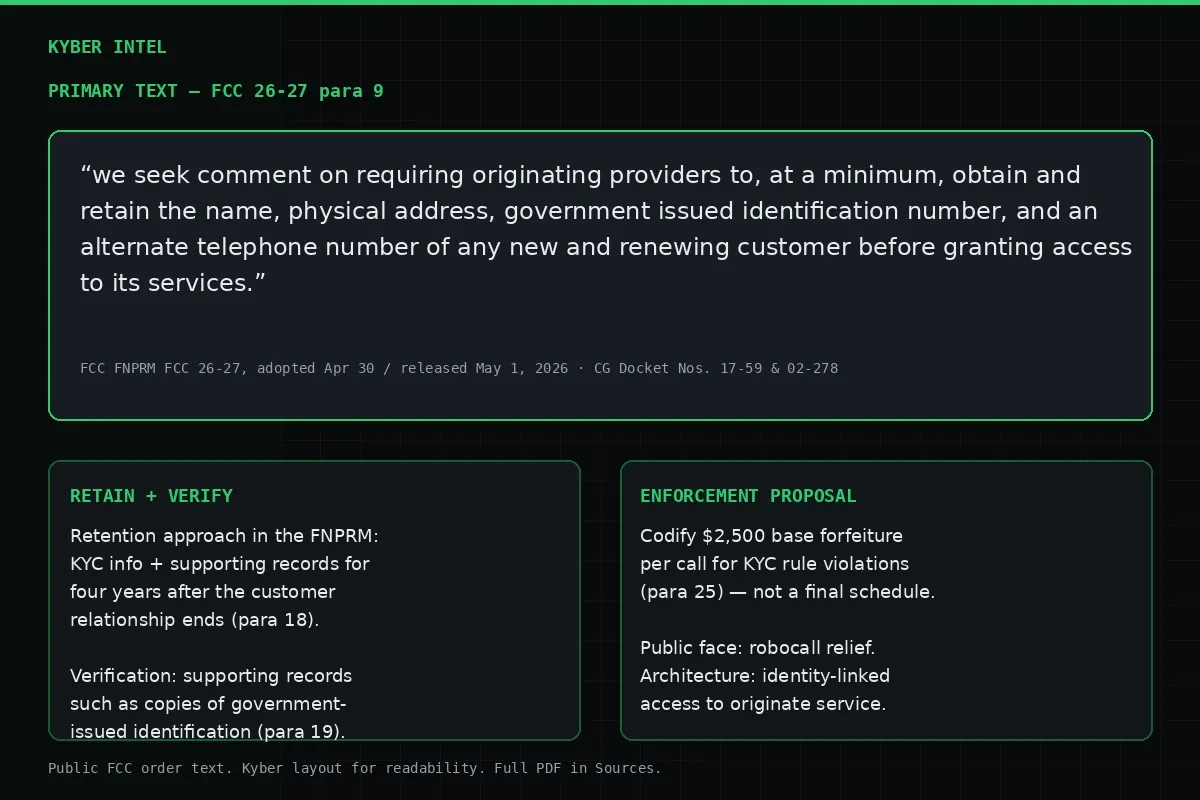
Source: FCC 26-27 public order text. Kyber layout for readability. Full PDF in Sources.
Existing rules already tell originating providers to take “affirmative, effective” measures to know their customers and keep their networks from originating illegal traffic (47 C.F.R. § 64.1200(n)(4), as discussed in the FNPRM). FCC 26-27 says that general duty is too soft. Paragraph 3 lists the project: specify customer identification for new and renewing customers; verification, retention, and re-verification; more data from high-volume customers; interplay with call branding; and per-call penalties.
Then paragraph 9 does the load-bearing work:
Specifically, we seek comment on requiring originating providers to, at a minimum, obtain and retain the name, physical address, government issued identification number, and an alternate telephone number of any new and renewing customer before granting access to its services.
High-volume, business, and foreign customers draw still more: intended use of the service and, where applicable, the IP address from which each call will be placed.
Paragraph 18 ties retention to the Commission’s four-year limitations thinking: originating providers would be required to retain KYC customer information and supporting records for four years following termination of the customer relationship — and the item seeks comment on that approach. Paragraph 19 seeks comment on verification with supporting records such as copies of government-issued identification.
That is not “maybe jot down a nickname at the prepaid counter.” That is a durable identity dossier held by the company that puts your voice on the public network.
Prepaid is not safely carved out
If you only read the word “robocall,” you might assume this is about bulk VoIP gateways. The order refuses that comfort.
Paragraph 14 asks whether customer-information requirements should vary for prepaid vs postpaid, retail store vs online, and third-party prepaid SIM vendors. It asks what carriers already collect from prepaid SIM buyers, what share of prepaid is in-person, and to what extent “bad actors” use prepaid for illegal calls — including other crimes.
Open questions are not exemptions. They are the design surface where anonymous prepaid either dies, gets a fig-leaf carve-out, or becomes a second-class path with enough friction to erase it in practice. Do not take comfort from the fact that the Commission asked. That is how the record gets built for the answer you will not like.
Who benefits
Agencies and enforcers get a cleaner subscriber identity graph at the point of origination. The FNPRM is explicit that better KYC should make it easier to identify scammers when they do get on the network. Chairman Carr’s attached statement sells the same story: some providers do the bare minimum; close the gaps; tie fines to harm with per-call penalties.
Large carriers absorb compliance as a moat. KYC programs, ID verification vendors, and retention systems are fixed costs. Small originating providers and prepaid specialists eat them harder. The order even asks about smaller-provider burdens — which is how you know the burdens are real.
Identity and fraud vendors get another mandatory market: document capture, database checks, re-verification cycles.
Everyone who needed a phone that was not a permanent nameplate loses optionality: domestic-violence survivors establishing a clean line, journalists and sources, whistleblowers, unhoused people without a stable address, foster youth, anyone who has watched a carrier breach dump driver’s licenses into the wild.
The CDT-led letter of July 27 — signed by sixteen groups including EFF, ACLU, EPIC, Access Now, NNEDV, and others — puts that list in the record on the reply-comment deadline. It is advocacy, not a court holding. It is still the clearest organized counter-brief against turning every line into a government-ID tether.
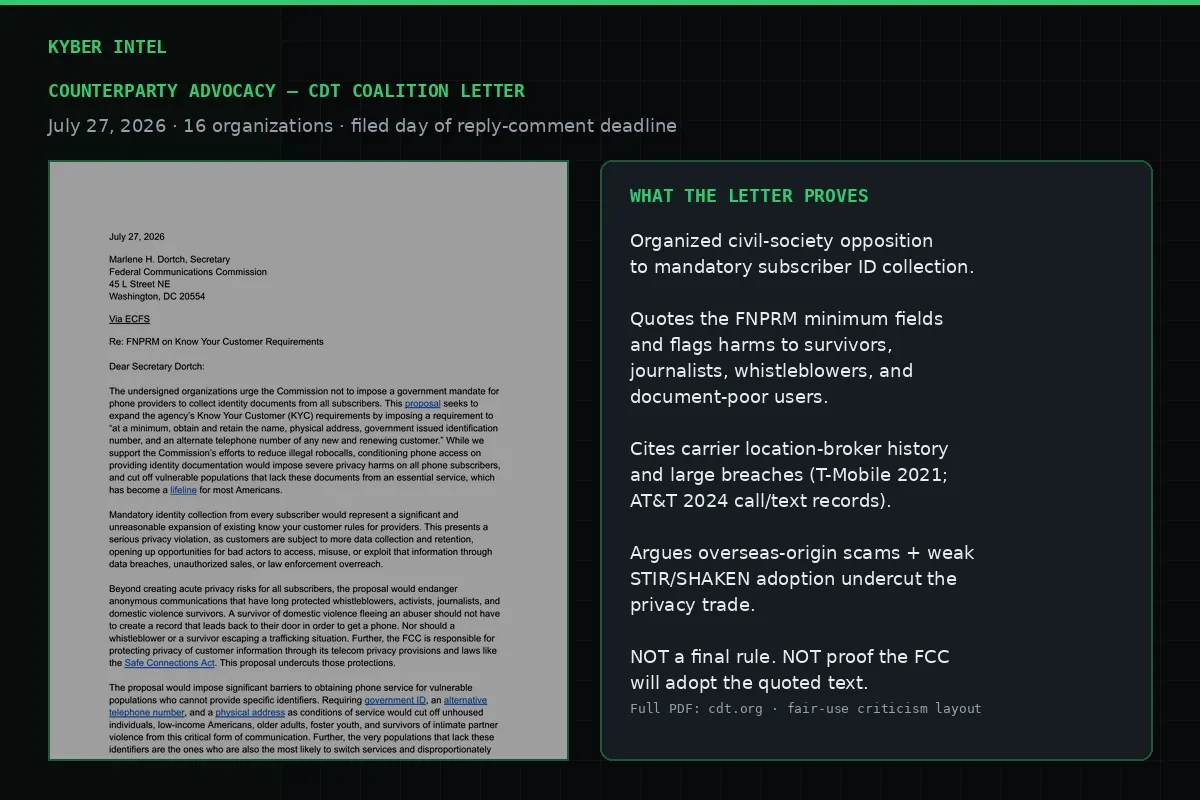
Source: CDT et al. letter PDF, July 27, 2026. Fair-use criticism layout. Full PDF linked in Sources. Advocacy filing — not an FCC decision.
Vendor and agency position
FCC / Carr: Illegal robocalls remain the top consumer-protection priority. Originating providers are the choke point before a call enters the network. Enhanced KYC plus per-call forfeitures are how you stop “bare minimum” vetting. Trusty’s statement adds that robust KYC can block bad actors and equip law enforcement — the dual-use sentence worth reading twice.
Civil society (CDT coalition): Do not impose a government mandate for phone providers to collect identity documents from all subscribers. The quoted minimum fields create acute privacy risk, endanger anonymous communications the Safe Connections Act world is supposed to protect, and wall off people who lack documents. Carrier custody is historically leaky (location sales to brokers; T-Mobile 2021 ID/SSN-scale breach; AT&T 2024 call/text records exposure — as characterized in the letter). FTC findings that a significant share of illegal robocalls originate overseas, plus incomplete STIR/SHAKEN adoption, undercut the privacy trade.
Secondary press: 404 Media’s free lede frames the package as killing burner phones; ACLU’s Jay Stanley is quoted comparing the direction of travel to authoritarian SIM-registration regimes. Techdirt treats the plan as surveillance-friendly under robocall branding. Useful temperature check. The order text still rules the fact pattern.
Scope map
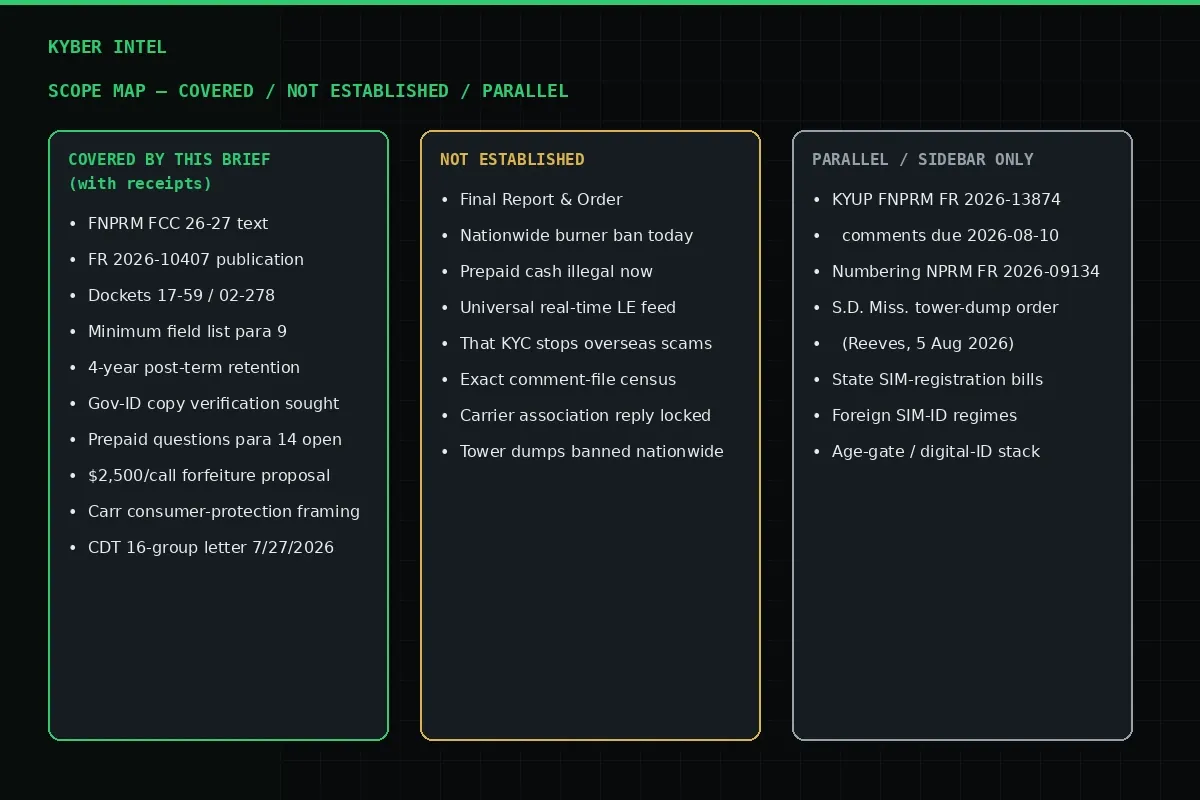
Kyber editorial scope map for this brief. Use it before upgrading any claim in conversation or follow-up posts.
Parallel dockets matter without collapsing into one blob:
- Know-Your-Upstream-Provider / STIR/SHAKEN FNPRM, FR Doc 2026-13874 (July 9, 2026): provider-to-provider diligence and authentication. Comments due August 10, 2026; replies September 8, 2026. Different instrument. Still part of the same robocall-control stack.
- Numbering / TRACED customer-knowledge NPRM, FR Doc 2026-09134 (May 8, 2026): how numbering resources are used and resold. Adjacent, not identical.
Sidebar — location dragnets lose a particularity fight the same week
While KYC tries to name every subscriber up front, reverse-location warrants keep trying to name everyone near a tower after the fact. On August 5, 2026, Judge Carlton W. Reeves (S.D. Mississippi, No. 3:25-CR-38) denied the government’s motion to reverse a magistrate’s rejection of four tower-dump warrants and held tower dumps per se unconstitutional as general warrants on the facts and law before that court (DocumentCloud PDF of Doc. 41).
One district court. Not the Supreme Court. Not a national off-switch for historical dumps, broker location products, or ALPR graphs. It is still the right architectural rhyme: when particularity bites one haystack, institutions reach for another. KYC is the pre-crime version of the same instinct — collect the identity so you do not have to guess later.
Practical exits (lawful)
No part of this brief is a guide to evade lawful process, fabricate identity documents, or commit fraud. The point is policy resistance and channel ownership.
-
Track the instrument, not the vibe. FCC 26-27 / FR 2026-10407 is proposed. Watch for a Report & Order, altered field lists, prepaid carve-outs, and effective dates on ECFS and the Federal Register. Do not announce “burners are illegal tomorrow” until the final text says so.
-
If you still have a comment path, use the real dockets. The dated comment/reply windows for FR 2026-10407 are closed as of this publication. The parallel KYUP FNPRM (FR 2026-13874) still listed comments due August 10, 2026 at research close — different rule, same stack. File facts, not slogans: survivor workflows, journalist source protection, unhoused address barriers, breach history, STIR/SHAKEN gaps.
-
Build non-phone high-sensitivity channels now. Domain email you control, already-established Signal or Session identities, in-person key exchange for the people who matter. A phone number is increasingly a public identifier bolted to KYC, apps, and recovery flows. Stop making it the root of trust for anything you cannot afford to lose.
-
Survivors: the Safe Connections Act and advocate networks (including NNEDV, a CDT letter signatory) exist because abusers weaponize accounts and numbers. A KYC mandate can collide with those protections. Work with advocates and counsel on jurisdiction-specific options; this article is not individualized legal advice.
-
State copycats. When Washington floats SIM-style identity rules, states copy the branding. Oppose “anti-scam” bills that are actually retail identity mandates. Demand particularity: bulk VoIP gateway abuse is not the same fact pattern as a single prepaid handset.
-
Carrier hygiene without theater. Assume breach. Minimize what sits in account portals. Prefer providers with clearer data practices when you have a real choice — and still do not confuse marketing with math.
-
Creators and small operators. Your audience should not live only inside a phone number or a single app login. Own the domain, the email list, and the export path. Kyber’s commercial wedge is still platform-dependency reduction; telephony KYC is another reason the phone number is a terrible sole root of identity.
What Kyber will watch next
- Report & Order or further FNPRM text in CG Docket Nos. 17-59 and 02-278.
- Final prepaid/SIM-retail treatment and any “risk-based” tiers that become de facto universal ID.
- Which verification vendors carriers select and whether ID images become a secondary breach class.
- State bills that clone the federal framing.
- Whether KYUP/STIR-SHAKEN work actually targets gateway abuse — or just decorates the identity mandate.
- Appellate fate of the Mississippi tower-dump order as a location-dragnet marker.
Bottom line
Scam calls are real. So is the habit of solving hard enforcement problems by putting a nameplate on the entire population.
FCC 26-27 is still a proposal. Read it that way. Then read the minimum fields again. If those four data points become the price of a dial tone, “anonymous phone” joins the museum next to anonymous cash and anonymous browsing — not because the public voted for a papers-please network, but because robocall relief was the costume that fit.
Own your channels before the costume becomes the uniform.
Sources
- https://docs.fcc.gov/public/attachments/FCC-26-27A1.pdf
- https://www.federalregister.gov/documents/2026/05/26/2026-10407/enhancing-know-your-customer-requirements
- https://www.govinfo.gov/content/pkg/FR-2026-05-26/pdf/2026-10407.pdf
- https://cdt.org/wp-content/uploads/2026/07/CDT_FCC_Know-Your-Customer_Sign-On-Letter.pdf
- https://www.404media.co/fcc-wants-to-kill-burner-phones-by-forcing-telecoms-to-get-all-customers-ids/
- https://www.techdirt.com/2026/08/07/16-groups-warn-fccs-new-robocall-plan-is-really-about-dramatically-undermining-privacy/
- https://www.techdirt.com/2026/05/19/new-trump-fcc-plan-to-fight-robocalls-raises-red-flags-and-major-privacy-concerns/
- https://www.federalregister.gov/documents/2026/07/09/2026-13874/enhancing-know-your-upstream-provider-requirements-and-strengthening-stirshaken-call-authentication
- https://s3.documentcloud.org/documents/28538589/towerdumpsreevesopn080526.pdf
- https://kyberintel.com/blog/five-bills-one-permission-layer/
- https://kyberintel.com/blog/phone-unlocking-is-the-exit-door-carriers-want-to-brick-shut/
- https://kyberintel.com/blog/remote-attestation-is-how-your-phone-becomes-a-permission-slip/
- https://kyberintel.com/blog/texas-didnt-lose-age-gates-it-lost-the-filter-mandate/