X's Handle Hostage Scheme: How Elon's Platform Extorts Small Businesses
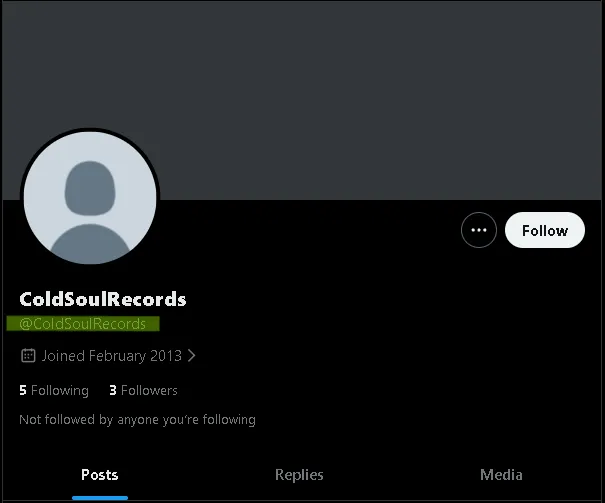
I run an independent record label called Cold Soul Records. We’ve been operating since 2020, releasing music, building artists, doing the work. There’s just one problem: someone registered @coldsoulrecords on Twitter back in 2013 and never did anything with it.
The account has 3 followers. Zero tweets. A completely blank profile. It’s been sitting there for over a decade, doing nothing, representing no one.
So I did what any reasonable business owner would do. I tried to claim it.
What followed was a masterclass in platform extortion.
The Runaround
I started with the standard routes. Password recovery? No access to whatever ancient email was used in 2013. Support tickets? Generic responses pointing me to policies that offer no actual path forward.
X’s official stance on inactive usernames is refreshingly honest in its hostility: “We cannot release inactive usernames at this time.” Not “we’re working on it.” Not “here’s an alternative process.” Just no.
Fine. I looked into trademark claims. I have a legitimate, operating business. I have the domain. I’ve been actively using the Cold Soul Records name for years while this ghost account collects digital dust. Surely that counts for something?
It does. It counts for exactly $200 per month.
The Shakedown
Here’s how X’s “trademark claim” process actually works in 2025:
- You identify a dormant account squatting on your brand name
- You file a claim with supporting documentation
- X tells you to purchase Premium+ ($40/month) to be eligible
- You purchase Premium+
- X denies your request, informing you that since you’re a business, you need Business Premium+ ($200/month)
- Here’s the kicker: you can never unsubscribe
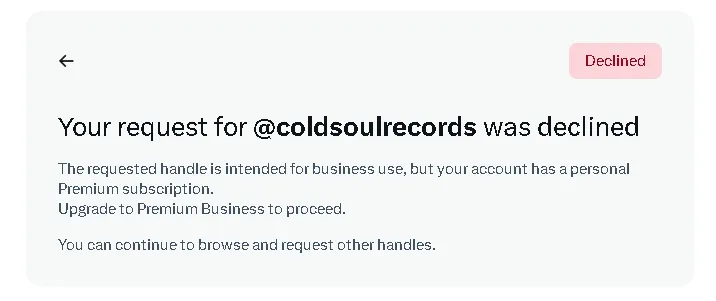
That last part deserves emphasis. This isn’t a one-time administrative fee for the handle transfer. It’s not even an annual licensing cost. It’s perpetual rent. The moment you stop paying $200/month, you lose the handle you “claimed.”
Let me do the math: $200 × 12 months = $2,400 per year, forever, to use a username that’s been abandoned for a decade.
That’s not a policy. That’s a protection racket.
The Sleaze Factor
What makes this particularly egregious is the bait-and-switch. X doesn’t tell you upfront that Business Premium is required. They let you pay for regular Premium first, then move the goalposts. It’s designed to extract maximum payment from people who’ve already committed to the process.
And let’s be clear about what X is actually selling here: nothing. They’re not providing a service. They’re not doing work. They’re not creating value. They’re charging you rent to remove an obstacle they could remove for free.
The dormant account isn’t using resources. It isn’t serving users. It exists only as leverage to extract money from the legitimate business owner who wants it.
This is artificial scarcity weaponized against small businesses.
Who This Hurts
Big corporations with legal departments and PR budgets? They’ll pay the ransom or send lawyers. It’s a rounding error.
But independent creators? Small labels? Solo founders? We’re the ones who get squeezed. $2,400/year is:
- A full marketing campaign for an album release
- Paid promotion across multiple platforms
- Professional mixing on several tracks
- A significant chunk of studio time
- Actual artist development
And X wants us to light that money on fire annually, forever, for a username.
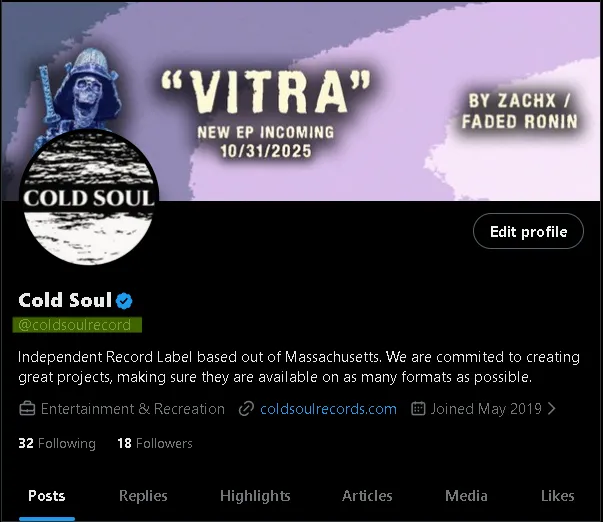
Many of us will do what I did: shrug, accept the close-enough alternative (@coldsoulrecord in my case), and move on. X doesn’t care. They’ve created a system where the “whales”—businesses desperate or wealthy enough to pay—subsidize the platform while everyone else learns to live with second-best.
The Bigger Picture
This isn’t an isolated policy quirk. It’s part of X’s broader pivot toward aggressive monetization at the expense of user experience. Verification as a paid service. Algorithmic suppression of accounts that don’t pay. API pricing that killed third-party apps. And now, handle ransoming.
Elon Musk bought Twitter promising to fight bots and restore free speech. Instead, he’s built a platform that:
- Sells verification to anyone with a credit card (including bots)
- Throttles reach for non-paying users
- Holds brand names hostage behind paywalls
- Provides functionally zero customer support
The through-line isn’t ideology. It’s extraction. Every policy decision asks the same question: “How do we squeeze more money from people who have no alternative?”
What You Can Do
If you’re a small business owner facing this same situation, here’s my honest advice:
Don’t pay the ransom. The moment you do, you’re locked into paying forever. That money is better spent on literally any other marketing channel.
Document everything. Screenshot the support responses, the tier requirements, the policy pages. When platforms behave badly, receipts matter.
Build elsewhere. X’s user base is declining. Advertiser revenue is cratering. The platform’s long-term viability is genuinely uncertain. Don’t over-invest in a channel that treats you as a revenue extraction target rather than a user.
Talk about it. This article exists because I decided to write about my experience instead of quietly accepting it. The more small business owners share these stories, the harder it becomes for X to pretend this is normal or acceptable.
The Irony
I’ll be posting this article on X (using my @coldsoulrecord handle, one letter short of my actual brand name) because that’s still where some of my audience lives. The irony isn’t lost on me.
But I’ll also be posting it everywhere else. And I’ll be investing my time and energy into platforms that don’t treat their users as hostages.
X had a chance to be the “town square” Elon promised. Instead, it’s become a tollbooth.
Cold Soul Records continues to operate at @coldsoulrecord on X, and everywhere else we can build without paying ransom. If you’ve had a similar experience with X’s handle policies, I’d love to hear about it.